
As shown on the Tehran location map, Tehran is situated in the north-central part of Iran at the foot of the Alborz mountain range. It is the capital and largest city of Iran and serves as the political, cultural and economic centre of the country.
Tehran Location on the Map
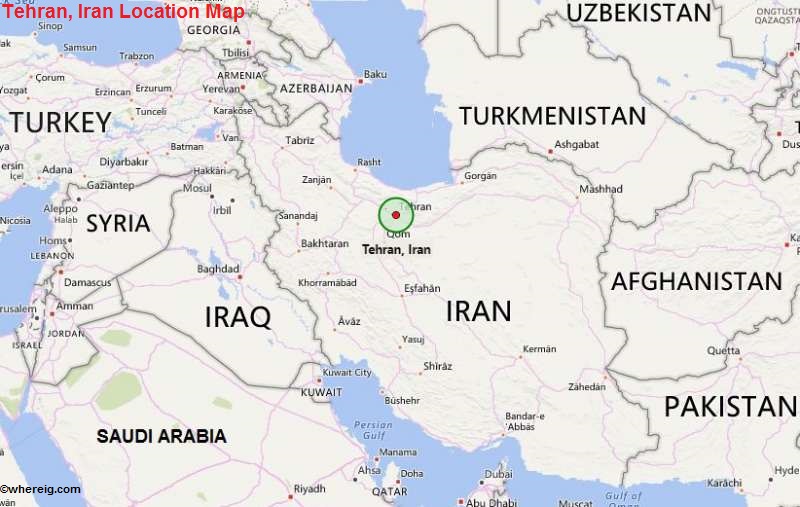
About Map: The map shows the location of Tehran in Iran, situated in the northern part of the country near the southern slopes of the Alborz Mountains.
Know Where is Strait of Hormuz | Where is Kharg Island | Iran Location Map
Where is Tehran Located?
Tehran is located in Tehran Province in the country of Iran. The city lies in the north-central part of the Iran along the southern slopes of the Alborz Mountains and south of the Caspian Sea. It serves as the capital and largest city of the country. Tehran became the capital of Iran in 1796 under the Qajar dynasty and has since developed into the political, economic, and cultural center of the nation. Today, it serves as the headquarters of government institutions, major industries, universities, and international businesses.
Tehran’s central location in north-central Iran makes it a major transportation hub connecting northern, western, southern, and eastern regions of the country through national highways, railways, and air routes.
Modern Tehran is a major political and economic centre. Notable landmarks include Azadi (Freedom) Tower and Milad Tower. The city hosts a large share of Iran’s government institutions, financial services, and industrial activity.
Population
According to official census data, the population of Tehran is approximately 8,693,706 as recorded in the 2016 national census, and the population density is approximately 32,000 people per square mile.
Area and Geography
Tehran covers a total area of approximately 270 square miles (about 707 square kilometers). The city stretches from the plains in the south to higher elevations in the north near the Alborz foothills. Northern districts are cooler and greener, while southern areas are more densely built and urbanized. Tehran’s location between mountain ranges and desert terrain influences its climate, with hot summers and relatively cold winters.
Attractions and Recreation
The city has historical significance and is home to important mosques, churches, synagogues, and Zoroastrian fire temples, reflecting Iran’s cultural and religious heritage.
Major attractions include the Grand Bazaar, Golestan Palace (a UNESCO World Heritage Site), the National Museum of Iran, and Milad Tower. Large public parks such as Mellat Park and Jamshidieh Park provide recreational spaces, while the nearby Alborz Mountains offer hiking, climbing, and winter skiing opportunities.
The city is also home to leading institutions such as the University of Tehran and Sharif University of Technology, contributing significantly to higher education and research in Iran.
Transportation
Tehran has an extensive transportation network that connects it to major regions across Iran. Key highways include the Tehran–Karaj Freeway (Freeway 2), Tehran–Qom Freeway (Freeway 7), Tehran–Saveh Freeway (Freeway 5), and the Tehran–Pardis Freeway. Urban mobility is supported by the Tehran Metro, one of the largest rapid transit systems in the Middle East, with multiple lines serving millions of passengers daily. The city also operates a Bus Rapid Transit (BRT) system that covers major corridors.
Tehran is served by two primary airports: Imam Khomeini International Airport (IKA), which handles most international flights, and Mehrabad International Airport, which primarily serves domestic routes. These facilities provide strong national and global connectivity.
Nearby major cities include Karaj to the west, Qom to the south, and Sari to the northeast, reflecting Tehran’s strategic central position within Iran.
Sources:
Population and area data sourced from the Statistical Center of Iran (National Census) and general city information referenced from the Official Tehran Municipality Portal and national transportation authorities.
Tehran Facts
| Country | Iran |
| Province | Tehran Province |
| Status | Capital City of Iran |
| Location | North-central Iran, on the southern slopes of the Alborz Mountains |
| Coordinates | 35.6892° N, 51.3890° E |
| Became Capital | 1796 (under Agha Mohammad Khan Qajar) |
| Total Area (City Proper) | 730 square kilometers (282 square miles) |
| Population (City Proper, 2016 Census) | 8,693,706 |
| Estimated Population (City Proper, 2024) | Approximately 9,500,000–9,700,000 |
| Population (Metropolitan Area, Estimated 2024) | Approximately 15,000,000–16,000,000 |
| Elevation | Approximately 1,200 meters (3,937 feet) above sea level |
| Climate | Cold semi-arid climate (BSh), with hot dry summers and cool to cold winters |
| Time Zone | UTC+3:30 (Iran Standard Time - IRST) |
| Major Landmarks | Azadi Tower, Milad Tower, Golestan Palace (UNESCO World Heritage Site), Grand Bazaar |
| Major Airports | Imam Khomeini International Airport (IKA), Mehrabad International Airport |
| Metro System | Tehran Metro (7 active lines, one of the largest in the Middle East) |
| Area Code | 021 |
| Economic Role | Political, economic, financial, industrial, and cultural center of Iran |
Distance from Tehran to Major Cities in Iran
The following table shows approximate straight-line (air) distances from Tehran to major cities across Iran.
| City | Distance (Kilometers) | Distance (Miles) |
| Karaj | 42 km | 26 mi |
| Qom | 128 km | 80 mi |
| Qazvin | 143 km | 89 mi |
| Hamadan | 282 km | 175 mi |
| Zanjan | 285 km | 177 mi |
| Isfahan | 338 km | 210 mi |
| Sanandaj | 403 km | 251 mi |
| Kermanshah | 426 km | 265 mi |
| Yazd | 502 km | 312 mi |
| Tabriz | 528 km | 328 mi |
| Ahvaz | 548 km | 341 mi |
| Urmia | 603 km | 375 mi |
| Shiraz | 685 km | 426 mi |
| Mashhad | 741 km | 460 mi |
| Bandar Abbas | 1,050 km | 652 mi |
| Zahedan | 1,120 km | 696 mi |
Distance from Tehran to Major Cities in the Middle East
The following list shows approximate straight-line (air) distances from Tehran to important cities across the Middle East region.
- Baghdad, Iraq – 695 km (432 miles)
- Basra, Iraq – 865 km (537 miles)
- Kuwait City, Kuwait – 780 km (485 miles)
- Riyadh, Saudi Arabia – 1,300 km (808 miles)
- Jeddah, Saudi Arabia – 1,950 km (1,212 miles)
- Doha, Qatar – 1,120 km (696 miles)
- Manama, Bahrain – 1,050 km (652 miles)
- Abu Dhabi, UAE – 1,250 km (776 miles)
- Dubai, UAE – 1,200 km (746 miles)
- Muscat, Oman – 1,460 km (907 miles)
- Ankara, Turkey – 1,700 km (1,056 miles)
- Istanbul, Turkey – 2,040 km (1,267 miles)
- Baku, Azerbaijan – 537 km (334 miles)
- Yerevan, Armenia – 790 km (491 miles)
- Tbilisi, Georgia – 890 km (553 miles)
- Damascus, Syria – 1,350 km (839 miles)
- Amman, Jordan – 1,600 km (994 miles)
- Jerusalem, Israel – 1,580 km (982 miles)
- Beirut, Lebanon – 1,450 km (901 miles)
- Sana’a, Yemen – 2,200 km (1,367 miles)
- Where is Afghanistan
- Where is Armenia
- Where is Azerbaijan
- Where is Bahrain
- Where is Bangladesh
- Where is Bhutan
- Where is Brunei
- Where is Cambodia
- Where is China
- Where is Georgia
- Where is Hong Kong
- Where is India
- Where is Indonesia
- Where is Iran
- Where is Iraq
- Where is Israel
- Where is Japan
- Where is Jordan
- Where is Kazakhstan
- Where is Kuwait
- Where is Kyrgyzstan
- Where is Laos
- Where is Lebanon
- Where is Macau
- Where is Malaysia
- Where is Maldives
- Where is Mongolia
- Where is Myanmar
- Where is Nepal
- Where is North Korea
- Where is Oman
- Where is Pakistan
- Where is Philippines
- Where is Qatar
- Where is Russia
- Where is Saudi Arabia
- Where is Singapore
- Where is South Korea
- Where is Sri Lanka
- Where is Syria
- Where is Taiwan
- Where is Tajikistan
- Where is Thailand
- Where is Turkey
- Where is Turkmenistan
- United Arab Emirates
- Where is Uzbekistan
- Where is Vietnam
- Where is Yemen
- Where is Abu Dhabi
- Where is Amman
- Where is Ankara
- Where is Baghdad
- Where is Baku
- Where is Bangkok
- Where is Bangalore
- Where is Beijing
- Where is Bishkek
- Where is Damascus
- Where is Dhaka
- Where is Dubai
- Where is Doha
- Where is Hanoi
- Where is Islamabad
- Where is Jakarta
- Where is Jerusalem
- Where is Kabul
- Where is Kathmandu
- Where is Kuala Lumpur
- Where is Kuwait City
- Where is Manila
- Where is Moscow
- Where is Mumbai
- Where is Muscat
- Where is New Delhi
- Where is Riyadh
- Where is Sanaa
- Where is Shanghai
- Where is Seoul
- Where is Taipei
- Where is Tehran
- Where is Tokyo