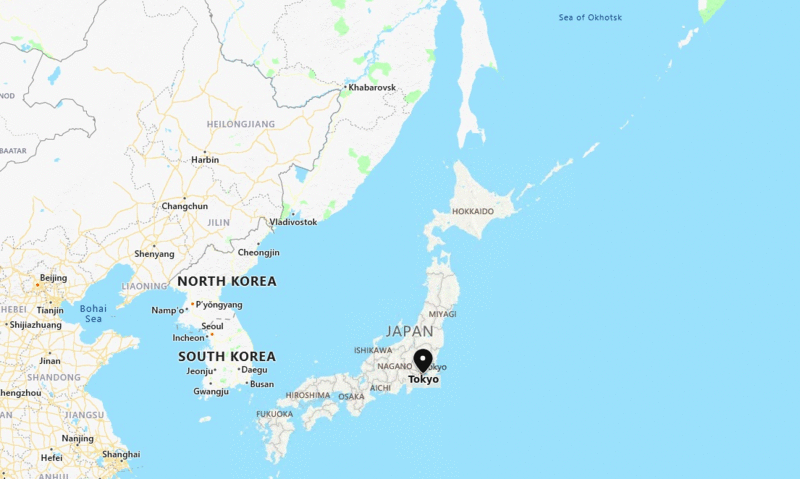
Tokyo is situated at the head of Tokyo Bay, of the Kantō region on the central Pacific coast of Japan's main island of Honshu. Tokyo is the capital city of Japan and the Metropolis region is one of the 47th prefectures of Japan. Tokyo metropolis was evolved after the merger of Tokyo prefecture and Tokyo city in the year 1943. By virtue of being the capital city, Tokyo is the home of the Japanese Imperial Family and also homes seat of Japanese Government.
Surprisingly, with the population about 35 million people, Tokyo metropolitan area is the largest metropolitan area in the world. In addition, with GDP of US$1.479 trillion at purchasing power parity (in 2008), it is also the largest metropolitan economy of the world; New York City rank comes after Tokyo. Probably, this is the reason that Tokyo is considered as one of the three "command centers" for the world economy, along with New York City and London.
This city is listed as an alpha+ world city by the GaWC's 2008 inventory and ranked third among global cities by Foreign Policy's 2010 Global Cities Index. Tokyo was named the second most expensive city for expatriate employees for the year 2010, as per the report given by the Mercer and Economist Intelligence Unit cost-of-living surveys. As per the report given by Monocle magazine, Tokyo is named as fourth Most Livable City and the World's Most Livable Megalopolis.
Tokyo Metro, Toei Subway, JR Urban Rail and Bus Networks
Shuto Expressway - Urban expressway network serving central Tokyo and surrounding districts.
Tomei Expressway - Connects Tokyo with Nagoya and Osaka.
Tohoku Expressway - Major route linking Tokyo with northern Honshu.
Joban Expressway - Connects Tokyo with northeastern Japan.
Shinkansen Network - High-speed rail corridors linking Tokyo with major cities across Japan.
Key Landmarks and Places to Visit in Tokyo, Japan
Landmark Name
Type
Tokyo Skytree
Observation Tower
Sensō-ji Temple
Religious Site
Meiji Shrine
Religious Site
Tokyo Tower
Observation Tower
Imperial Palace
Historic Site
Shibuya Crossing
Urban Landmark
Ueno Park
Urban Park
Tokyo National Museum
Museum
Akihabara
Entertainment District
Odaiba
Waterfront District
Places to Visit in Tokyo, Japan
Landmark Name
Type
Tokyo Skytree
Observation Tower
Sensō-ji Temple
Religious Site
Meiji Shrine
Religious Site
Tokyo Tower
Observation Tower
Imperial Palace
Historic Site
Shibuya Crossing
Urban Landmark
Ueno Park
Urban Park
Tokyo National Museum
Museum
Akihabara
Entertainment District
Odaiba
Waterfront District
Colleges and Universities in Tokyo, Japan
Institution Name
Type
Level
Notable For
University of Tokyo
Public
University
Research excellence
Waseda University
Private
University
International studies
Keio University
Private
University
Business and innovation
Tokyo Institute of Technology
Public
University
Science and engineering
Sophia University
Private
University
Liberal arts education
Waterbodies in Tokyo, Japan
Tokyo Bay, Sumida River, Arakawa River, Tama River, Kanda River, Meguro River, Edo River, Shinobazu Pond, Kasai Rinkai Waterfront, Oi Canal
Golf Courses in Tokyo, Japan
Tokyo Yomiuri Country Club, Musashino Golf Club, Akigase Golf Club, Tokyo Classic Club, Fuchu Country Club, Hachioji Country Club, Tama Hills Golf Course, Wakasu Golf Links, Narashino Country Club, Sagamihara Golf Club
Tokyo, Japan - Key Historical Facts
Tokyo began as the fishing village of Edo and grew into a major political center during the Tokugawa shogunate.
In 1868, the Imperial capital moved from Kyoto to Edo, which was renamed Tokyo, meaning "Eastern Capital."
The city was heavily damaged during the 1923 Great Kantō Earthquake and rebuilt afterward.
Tokyo underwent rapid modernization and expansion following World War II.
The city hosted the Summer Olympics in 1964 and again in 2021.
Today, Tokyo is one of the world's largest metropolitan areas and a global center for finance, technology and culture.