
As shown in the given Denver location map that Denver is located in the Central part of the United States and northern region of state Colorado.
Denver Location Map
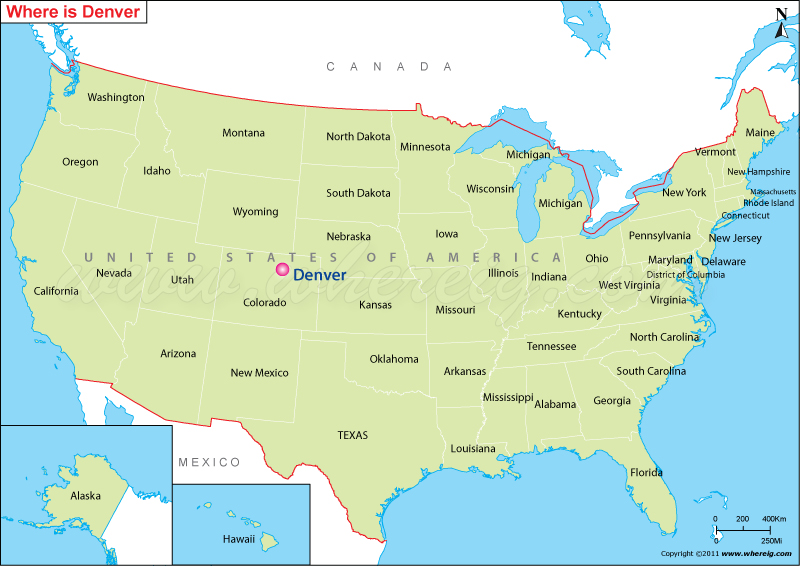
About Map: The Map showing where is Denver location in the U.S. State of Colorado.
More Maps
Where is Denver Located?
Denver is the capital and most populous city of the U.S. state of Colorado situated in the South Platte River Valley on the western edge of the High Plains just east of the Front Range of the Rocky Mountains.
Interestingly, the nickname of Denver is the "Mile-High City" because of its elevation i.e. precisely one mile (1.6 km) above sea level. At the time of its foundation, it was little more than a dusty collection of buildings on a long, grassy plain with a few contorted cottonwood and willow trees on riverbanks; but in the passage of time, it is one of the developed cities of the United States. The high-tech infrastructure and high rising building, national parks and mountainous landscapes also fascinate tourists.
<Denver, Colorado Quick Facts
| Fact | Details |
|---|---|
| City | Denver |
| County | City and County of Denver |
| State | Colorado |
| State Capital | Denver |
| US Region | West |
| Latitude | 39.7392° N |
| Longitude | 104.9903° W |
| Elevation | 5,280 ft (1,609 m) |
| Land Area | 153.0 sq mi |
| Water Area | 1.6 sq mi |
| Total Area | 154.6 sq mi |
| Population (2020 Census) | 715,522 |
| Population Density | Approximately 4,676 per sq mi |
| ZIP Codes | 80201-80212, 80214-80239, 80241, 80244, 80246-80252, 80256-80266, 80271-80274, 80281, 80290-80295, 80299 |
| Area Code | 303, 720, 983 |
| Time Zone Standard | Mountain Standard Time (MST, UTC-7) |
| Time Zone Daylight | Mountain Daylight Time (MDT, UTC-6) |
| Currency | US Dollar (USD) |
| FIPS Code | 08-20000 |
| Congressional District | Colorado 1st Congressional District |
Location and Surroundings
Denver is located in the City and County of Denver in north-central Colorado. It lies between the Great Plains to the east and the Rocky Mountains to the west along the Front Range Urban Corridor. The city is known for its outdoor recreation, government institutions, thriving economy, professional sports teams, and access to mountain destinations.
Nearby Cities to Denver, Colorado
- Lakewood, Colorado - 7 mi West
- Aurora, Colorado - 10 mi East
- Glendale, Colorado - 6 mi Southeast
- Commerce City, Colorado - 8 mi Northeast
- Englewood, Colorado - 8 mi South
- Westminster, Colorado - 10 mi Northwest
- Thornton, Colorado - 11 mi North
- Arvada, Colorado - 9 mi Northwest
- Littleton, Colorado - 11 mi South
- Golden, Colorado - 15 mi West
Denver, Colorado Climate and Weather Overview
| Month | Avg High (°F) | Avg Low (°F) | Avg Rainfall (in) |
|---|---|---|---|
| January | 48 | 18 | 0.4 |
| April | 62 | 34 | 1.7 |
| July | 89 | 59 | 2.2 |
| October | 66 | 37 | 1.0 |
| Annual | 67 | 38 | 14.5 |
| Climate Attribute | Details |
|---|---|
| Climate Classification (Köppen) | Cold Semi-Arid (BSk) |
| Annual Rainfall | About 14.5 inches |
| Annual Sunshine Days | Approximately 245 days |
| Hurricane/Tornado Risk | Low hurricane risk, moderate tornado risk |
| Snowfall | Approximately 56 inches annually |
Driving Distances from Denver, Colorado
| City | State | Distance (mi) | Approx. Drive Time |
|---|---|---|---|
| Aurora | Colorado | 10 | 15 min |
| Lakewood | Colorado | 7 | 15 min |
| Arvada | Colorado | 9 | 20 min |
| Westminster | Colorado | 10 | 20 min |
| Thornton | Colorado | 11 | 20 min |
| Littleton | Colorado | 11 | 20 min |
| Golden | Colorado | 15 | 25 min |
| Boulder | Colorado | 30 | 40 min |
| Colorado Springs | Colorado | 70 | 1 hr 15 min |
| Fort Collins | Colorado | 65 | 1 hr 10 min |
Transportation and Connectivity in Denver, Colorado
| Category | Details |
|---|---|
| Airport Name | Denver International Airport |
| IATA Code | DEN |
| Port | Not Applicable |
| Major Highways | I-25, I-70, I-76, US 6, US 85, US 287 |
| Train/Amtrak Service | Amtrak California Zephyr |
| Local Bus/Transit Service | Regional Transportation District (RTD) |
- Interstate 25 - Major north-south corridor connecting Denver with Colorado Springs and Fort Collins.
- Interstate 70 - Main east-west route linking Denver with the Rocky Mountains and Kansas.
- Interstate 76 - Connects Denver with northeastern Colorado and Nebraska.
- US Highway 6 - Provides regional access through the Denver metropolitan area.
- US Highway 85 - Connects Denver with southern Colorado communities.
- US Highway 287 - Links Denver with Fort Collins and northern Colorado.
Key Landmarks and Places to Visit in Denver, Colorado
| Landmark Name | Type |
|---|---|
| Denver Art Museum | Museum |
| Denver Botanic Gardens | Botanical Garden |
| Union Station | Historic Landmark |
| Colorado State Capitol | Government Building |
| Denver Zoo | Zoo |
| Coors Field | Sports Venue |
| Empower Field at Mile High | Sports Venue |
| Red Rocks Park and Amphitheatre | Natural Attraction |
| Museum of Nature & Science | Museum |
| Civic Center Park | Urban Park |
Top Places to Visit in Denver:
| Denver Botanic Gardens | Colorado State Capitol | Clyfford Still Museum | Cherry Creek State Park | Mount Falcon Park |
| Denver Art Museum | Molly Brown House Museum | Wings Over the Rockies Air & Space | Lakeside Amusement Park | Barr Lake State Park |
| Red Rocks Park and Amphitheatre | Downtown Aquarium | History Colorado Center | Larimer Square | Confluence Park |
| Denver Zoo | Water World | Clear Creek | Chatfield State Park | Pirates Cove Water Park |
| Elitch Gardens | 16th Street Mall | Rocky Mountain Arsenal National | Denver Botanic Gardens Chatfield | Cherry Creek Reservoir |
| Downtown Denver | Coors Field | Sloan Lake | Dinosaur Ridge | Robert F. Clement Park |
| Denver Museum of Nature & Science | Children's Museum of Denver at Marsico | Museum of Contemporary Art | Cherry Creek | Mile High Flea Market |
Waterbodies in Denver, Colorado
South Platte River, Cherry Creek, Sloan's Lake, Smith Lake, Ferril Lake, Berkeley Lake, Rocky Mountain Lake, Marston Reservoir, Chatfield Reservoir, Bear Creek
Golf Courses in Denver, Colorado
City Park Golf Course, Wellshire Golf Course, Overland Golf Course, Willis Case Golf Course, Kennedy Golf Course, CommonGround Golf Course, Cherry Hills Country Club, Green Valley Ranch Golf Club, Broken Tee Golf Course, Fossil Trace Golf Club
Economy and Major Employers in Denver, Colorado
| Sector | Major Employer or Industry | Notes |
|---|---|---|
| Government | State of Colorado | Denver serves as Colorado's capital city. |
| Aerospace | Lockheed Martin and Ball Aerospace | Major aerospace operations are located in the region. |
| Healthcare | UCHealth and Denver Health | Large healthcare systems support regional employment. |
| Finance | Banking and Financial Services | Denver is a regional financial center. |
| Technology | Software and Telecommunications Firms | Growing technology sector throughout the metro area. |
| Tourism | Hospitality and Convention Industry | Visitors are attracted by nearby mountain recreation. |
| Education | University and School Systems | Education remains a major employment sector. |
| Transportation | Denver International Airport | One of the world's busiest airports supports thousands of jobs. |
Colleges and Universities in Denver, Colorado
| Institution Name | Type | Level | Notable For |
|---|---|---|---|
| University of Denver | Private | University | Research, law, and business programs |
| University of Colorado Denver | Public | University | Urban research university and health sciences |
| Metropolitan State University of Denver | Public | University | Large public university serving the Denver metro area |
| Community College of Denver | Public | Community College | Workforce training and transfer programs |
| Johnson & Wales University - Denver | Private | University | Culinary arts and hospitality education |
| Rocky Mountain College of Art + Design | Private | College | Art, design, and creative studies |
| Colorado Christian University (Denver Center) | Private | University | Adult and graduate education programs |
| Arapahoe Community College | Public | Community College | Comprehensive two-year degree programs |
Denver, Colorado - Key Historical Facts
- Denver was founded in 1858 during the Pike's Peak Gold Rush and quickly became a center for mining activity.
- The city was named after James W. Denver, who served as governor of the Kansas Territory.
- Denver became the capital of Colorado when the state joined the Union in 1876.
- The arrival of the railroad in the nineteenth century helped transform Denver into a major transportation hub.
- Its elevation of 5,280 feet earned it the nickname "Mile High City."
- Denver grew rapidly throughout the twentieth century as a center for government, business, transportation, and tourism.
Sources
- Official City and County of Denver Website
- State of Colorado Official Website
- U.S. Census Bureau
- U.S. Geological Survey (USGS)
- National Weather Service
- Where is Akron
- Where is Anaheim
- Where is Anchorage
- Where is Arlington
- Where is Aurora
- Where is Baltimore
- Where is Baton Rouge
- Where is Birmingham
- Where is Boise City
- Where is Boston
- Where is Buffalo
- Where is Chandler
- Where is Charlotte
- Where is Chesapeake
- Where is Chula Vista
- Where is Cincinnati
- Where is Cleveland
- Where is Colorado Springs
- Where is Columbus
- Where is Corpus Christi
- Where is Des Moines
- Where is Detroit
- Where is Durham
- Where is El Paso
- Where is Fayetteville
- Where is Fort Wayne
- Where is Freemont
- Where is Fresno
- Where is Garland
- Where is Gilbert
- Where is Glendale
- Where is Greensboro
- Where is Henderson
- Where is Hialeah
- Where is Honolulu
- Where is Houston
- Where is Indianapolis
- Where is Irvine
- Where is Irving
- Where is Jacksonville
- Where is Jersey City
- Where is Kansas City
- Where is Laredo
- Where is Lincoln
- Where is Long Beach
- Where is Louisville
- Where is Lubbock
- Where is Madison
- Where is Memphis
- Where is Mesa
- Where is Milwaukee
- Where is Minneapolis
- Where is Modesto
- Where is Montgomery
- Where is Nashville
- Where is Newark
- Where is Norfolk
- Where is North Las Vegas
- Where is Oakland
- Where is Oklahoma City
- Where is Omaha
- Where is Orlando
- Where is Paradise
- Where is Philadelphia
- Where is Phoenix
- Where is Portland
- Where is Raleigh
- Where is Reno
- Where is Richmond
- Where is Riverside
- Where is Rochester
- Where is Sacramento
- Where is Saint Paul
- Where is Saint Petersburg
- Where is San Bernardino
- Where is San Jose
- Where is Santa Ana
- Where is Scottsdale
- Where is Shreveport
- Where is Spokane
- Where is St Louis
- Where is Stockton
- Where is Tampa
- Where is Toledo
- Where is Tucson
- Where is Tulsa
- Where is Virginia Beach
- Where is Wichita