
The map of Europe shows the continent’s countries, boundaries, and major regions. Europe has around 44 countries, with 27 of them part of the European Union (EU). Russia is the largest country by area, while Vatican City is the smallest. Europe is the second-smallest continent and is known for its strong economies, cultural diversity, and deep historical roots.
Political Map of Europe
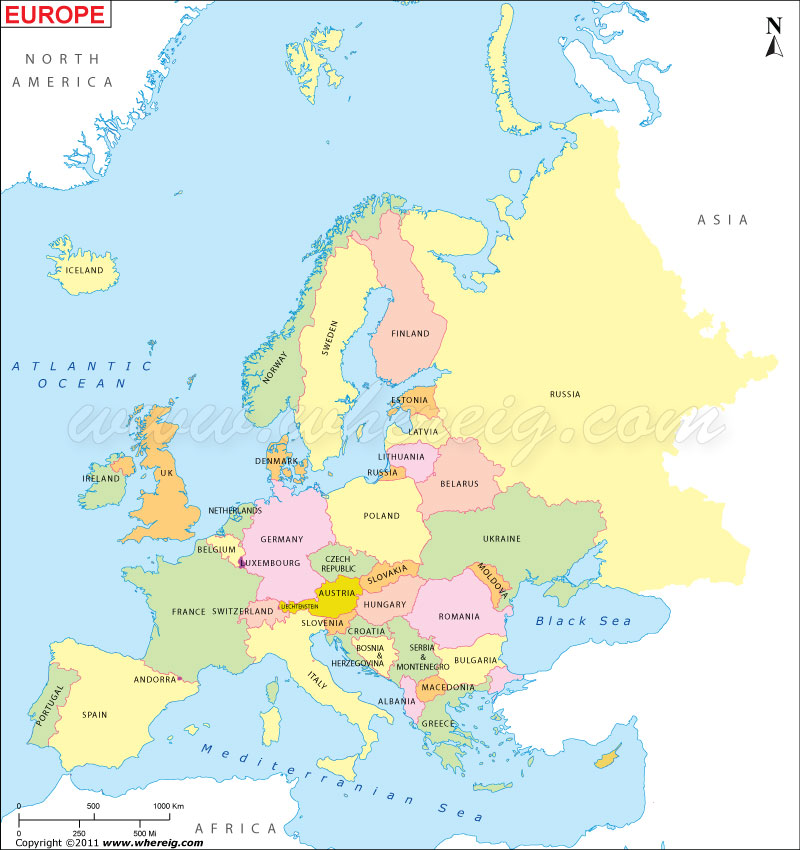
About Map: This political map of Europe highlights country boundaries, major nations, and their relative locations across the continent. Europe is located in the Northern Hemisphere, bordered by Asia to the east, Africa to the south across the Mediterranean Sea, the Atlantic Ocean to the west, and the Arctic Ocean to the north. It forms the western part of the larger Eurasian landmass.
Related Links
| Eastern European Countries | Western European Countries | Southern European Countries | Northern European Countries | Europe Outline Map |
| Africa Map | Asia Map | North America Map | South America Map | Oceania Map |
About Europe
The European continent includes many countries with diverse cultures and historical backgrounds. Europe, especially ancient Greece, is often seen as the birthplace of Western civilization. From the 16th century onward, Europe played a major role in global developments, particularly during the age of exploration and colonial expansion.
Europe forms the western part of the Eurasian landmass. Over time, it has developed into a region known for its cultural diversity, innovation, and influential social movements.
Also check European Countries and Capitals List
The continent is home to some of the world’s most scenic countries, including Germany, Switzerland, and Italy.
Europe is the world’s second-smallest continent, covering about 3.9 million square miles. Among its countries, Russia is the largest by area and population, while Vatican City is the smallest. Europe is also the third-most populous continent after Asia and Africa, with a population of around 733 million people.
Europe Map with Countries
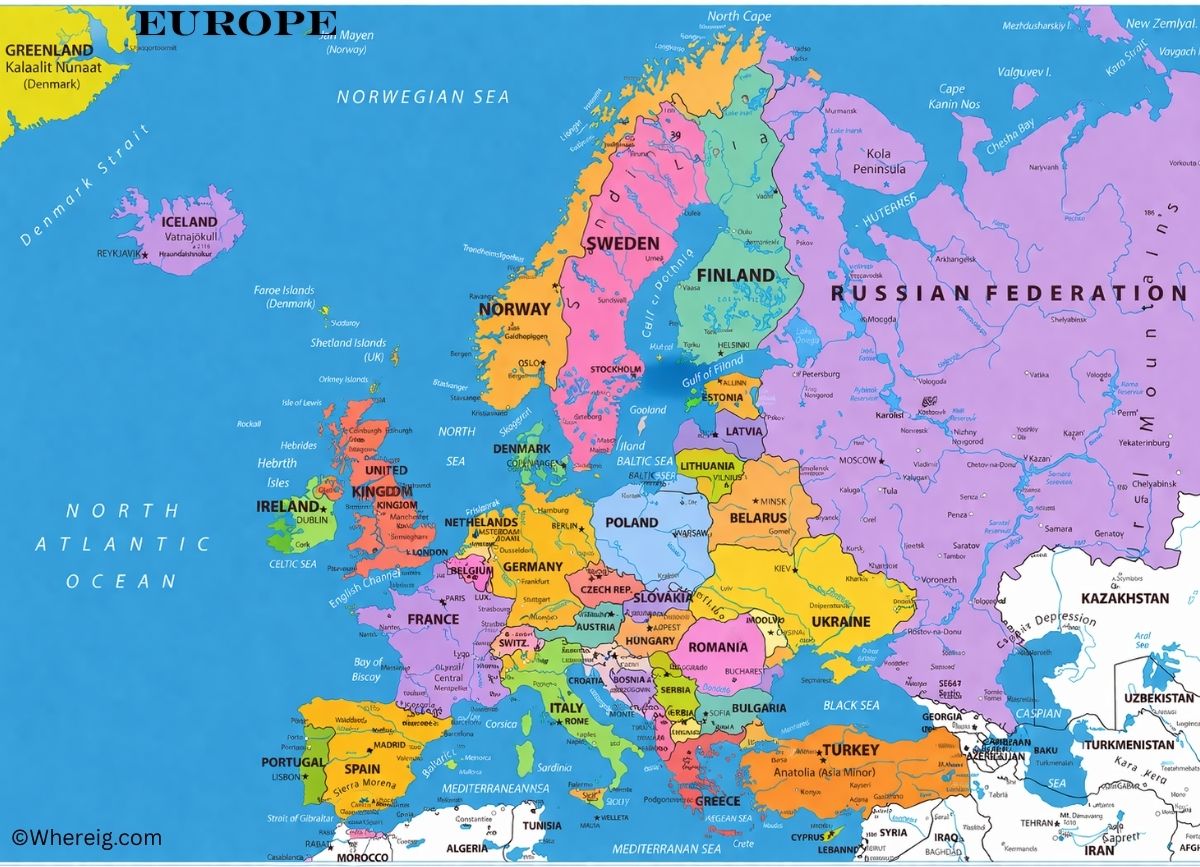
About Map: This map of Europe shows its countries, capital cities, and key physical features.
List of Countries in the Europe
| # | Country | Region | Population (2025 est.) | Total area (km2) | Total area (sq mi) |
|---|---|---|---|---|---|
| 1 | Albania | Southern Europe | 2,745,000 | 28,748 | 11,100 |
| 2 | Andorra | Southern Europe | 80,000 | 468 | 181 |
| 3 | Austria | Western Europe | 9,100,000 | 83,858 | 32,378 |
| 4 | Belarus | Eastern Europe | 9,150,000 | 207,600 | 80,200 |
| 5 | Belgium | Western Europe | 11,800,000 | 30,510 | 11,780 |
| 6 | Bosnia and Herzegovina | Southern Europe | 3,200,000 | 51,129 | 19,741 |
| 7 | Bulgaria | Eastern Europe | 6,400,000 | 110,994 | 42,855 |
| 8 | Croatia | Southern Europe | 3,850,000 | 56,594 | 21,851 |
| 9 | Czech Republic (Czechia) | Eastern Europe | 10,900,000 | 78,866 | 30,450 |
| 10 | Denmark | Northern Europe | 5,950,000 | 44,493 | 17,179 |
| 11 | Estonia | Northern Europe | 1,330,000 | 45,339 | 17,505 |
| 12 | Finland | Northern Europe | 5,600,000 | 338,145 | 130,559 |
| 13 | France | Western Europe | 65,600,000 | 551,695 | 213,011 |
| 14 | Germany | Western Europe | 84,400,000 | 357,386 | 137,988 |
| 15 | Greece | Southern Europe | 10,200,000 | 131,940 | 50,940 |
| 16 | Holy See | Southern Europe | 800 | 0.44 | 0.17 |
| 17 | Hungary | Eastern Europe | 9,550,000 | 93,030 | 35,920 |
| 18 | Iceland | Northern Europe | 395,000 | 102,775 | 39,682 |
| 19 | Ireland | Northern Europe | 5,300,000 | 70,273 | 27,133 |
| 20 | Italy | Southern Europe | 58,900,000 | 301,338 | 116,347 |
| 21 | Latvia | Northern Europe | 1,850,000 | 64,589 | 24,938 |
| 22 | Liechtenstein | Western Europe | 39,600 | 160 | 62 |
| 23 | Lithuania | Northern Europe | 2,860,000 | 65,300 | 25,200 |
| 24 | Luxembourg | Western Europe | 672,000 | 2,586 | 998 |
| 25 | Malta | Southern Europe | 563,000 | 316 | 122 |
| 26 | Moldova | Eastern Europe | 3,900,000 | 33,846 | 13,068 |
| 27 | Monaco | Western Europe | 39,000 | 2.02 | 0.78 |
| 28 | Montenegro | Southern Europe | 620,000 | 13,812 | 5,333 |
| 29 | Netherlands | Western Europe | 17,900,000 | 41,198 | 15,907 |
| 30 | Macedonia | Southern Europe | 2,050,000 | 25,713 | 9,928 |
| 31 | Norway | Northern Europe | 5,550,000 | 385,178 | 148,718 |
| 32 | Poland | Eastern Europe | 37,500,000 | 312,685 | 120,728 |
| 33 | Portugal | Southern Europe | 10,300,000 | 91,568 | 35,355 |
| 34 | Romania | Eastern Europe | 19,000,000 | 238,397 | 92,046 |
| 35 | Russia | Eastern Europe | 146,000,000 | 3,995,200 | 1,542,600 |
| 36 | San Marino | Southern Europe | 34,000 | 61 | 24 |
| 37 | Serbia | Southern Europe | 6,600,000 | 77,453 | 29,905 |
| 38 | Slovakia | Eastern Europe | 5,430,000 | 49,036 | 18,933 |
| 39 | Slovenia | Southern Europe | 2,120,000 | 20,273 | 7,827 |
| 40 | Spain | Southern Europe | 48,000,000 | 498,511 | 192,476 |
| 41 | Sweden | Northern Europe | 10,700,000 | 450,295 | 173,860 |
| 42 | Switzerland | Western Europe | 8,900,000 | 41,290 | 15,940 |
| 43 | Ukraine | Eastern Europe | 36,000,000 | 603,628 | 233,062 |
| 44 | United Kingdom | Northern Europe | 68,300,000 | 242,495 | 93,628 |
Capital Cities of Europe
- Albania – Tirana
- Andorra – Andorra la Vella
- Austria – Vienna
- Belarus – Minsk
- Belgium – Brussels
- Bosnia and Herzegovina – Sarajevo
- Bulgaria – Sofia
- Croatia – Zagreb
- Czechia – Prague
- Denmark – Copenhagen
- Estonia – Tallinn
- Finland – Helsinki
- France – Paris
- Germany – Berlin
- Greece – Athens
- Hungary – Budapest
- Iceland – Reykjavik
- Ireland – Dublin
- Italy – Rome
- Latvia – Riga
- Liechtenstein – Vaduz
- Lithuania – Vilnius
- Luxembourg – Luxembourg
- Malta – Valletta
- Moldova – Chisinau
- Monaco – Monaco
- Montenegro – Podgorica
- Netherlands – Amsterdam
- North Macedonia – Skopje
- Norway – Oslo
- Poland – Warsaw
- Portugal – Lisbon
- Romania – Bucharest
- Russia – Moscow
- San Marino – San Marino
- Serbia – Belgrade
- Slovakia – Bratislava
- Slovenia – Ljubljana
- Spain – Madrid
- Sweden – Stockholm
- Switzerland – Bern
- Ukraine – Kyiv
- United Kingdom – London
Major Cities in Europe by Population
Here are some of the largest cities in Europe based on population. These cities are important economic, cultural, and administrative centers across the continent.
| City | Country | Population |
|---|---|---|
| Moscow | Russia | 12.6 million |
| London | United Kingdom | 9.0 million |
| Saint Petersburg | Russia | 5.6 million |
| Berlin | Germany | 3.8 million |
| Madrid | Spain | 3.3 million |
| Kyiv | Ukraine | 3.0 million |
| Rome | Italy | 2.8 million |
| Paris | France | 2.1 million |
| Bucharest | Romania | 1.8 million |
| Vienna | Austria | 1.9 million |
| Hamburg | Germany | 1.9 million |
| Budapest | Hungary | 1.7 million |
| Warsaw | Poland | 1.8 million |
| Barcelona | Spain | 1.6 million |
| Munich | Germany | 1.5 million |
| Milan | Italy | 1.4 million |
| Prague | Czech Republic | 1.3 million |
| Sofia | Bulgaria | 1.3 million |
| Brussels | Belgium | 1.2 million |
| Stockholm | Sweden | 1.0 million |
Major Water Bodies in Europe
- Baltic Sea – Sweden, Finland, Russia, Estonia, Latvia, Lithuania, Poland, Germany, and Denmark
- North Sea – United Kingdom, Norway, Denmark, Germany, Netherlands, Belgium, and France
- Celtic Sea – Ireland, United Kingdom, and France
- English Channel – United Kingdom and France
- Mediterranean Sea – Spain, France, Italy, Greece, and other southern European countries
- Black Sea – Romania, Bulgaria, Ukraine, and Russia
- Denmark Strait – Iceland and Greenland (Denmark)
- Norwegian Sea – Norway and Iceland
- Gulf of Bothnia – Sweden and Finland
- Gulf of Finland – Finland, Estonia, and Russia
- Bay of Biscay – France and Spain
- Aegean Sea – Greece and Turkey
- Strait of Gibraltar – Spain and United Kingdom (Gibraltar)
Major Rivers in Europe
- Dnieper – Russia, Belarus, and Ukraine
- Danube – Germany, Austria, Hungary, Serbia, Romania, and Bulgaria
- Vistula – Poland
- Oder – Czech Republic, Poland, and Germany
- Rhine – Switzerland, Germany, and Netherlands
- Weser – Germany
- Elbe – Czech Republic and Germany
- Rhone – Switzerland and France
- Seine – France
- Loire – France
- Po – Italy
- Tagus – Spain and Portugal
- Douro – Spain and Portugal
- Ebro – Spain
- Kemi – Finland
- Tana – Norway and Finland
Facts about Europe
| Continent | Europe |
| Size | Second-smallest continent by area |
| Total Area | 10,180,000 sq km (3,930,000 sq mi) |
| Percentage of Earth’s Land | 6.8% |
| Number of Countries | 44–50 (depending on definitions) |
| Total Population | 750 million |
| Population Density | 73 people per sq km |
| Largest Country by Area | Russia (partly in Europe) |
| Largest Country by Population | Russia (European part) |
| Smallest Country by Area | Vatican City |
| Smallest Country by Population | Vatican City |
| Highest Point | Mount Elbrus - 5,642 m (Russia) |
| Lowest Point | Caspian Sea shoreline - −28 m |
| Largest City (Metro Area) | London |
| Major Cities | London, Paris, Berlin, Madrid, Rome, Amsterdam, Vienna, Brussels, Athens, Prague, Istanbul |
| Major Religions | Christianity, Islam, Judaism; growing secular population |
| Major Languages | English, German, French, Spanish, Italian, Russian |
| Political & Economic Unions | European Union (EU), Council of Europe |
| Time Zones | UTC −1 to UTC +5 |
| Climate | Temperate, Mediterranean, Continental, Arctic (north) |
| Internet TLD | .eu |
Natural Resources in Europe
Europe’s natural resources include fossil fuels, metals, and industrial minerals. Many of these have been used for centuries, especially in Western and Central Europe.
- Coal – Germany, Poland, Czech Republic
- Oil – Norway, United Kingdom, Russia
- Natural Gas – Russia, Norway, Netherlands
- Iron Ore – Sweden, Ukraine
- Copper – Poland, Spain
- Bauxite – Greece, Hungary, France
- Zinc – Ireland, Poland, Sweden
- Lead – Poland, Ireland
- Nickel – Finland, Russia
- Gold – Finland, Sweden
- Silver – Poland, Sweden
- Salt – Germany, United Kingdom, Poland
Europe has about 44 countries in most standard lists. Some counts go a bit higher depending on how borders are defined, but generally it includes both large nations like France and smaller ones such as Monaco or San Marino.
When people talk about major European countries, they usually mean Germany, France, the United Kingdom, Italy, Spain, and Russia. These countries stand out because of their size, economy, and global presence.
Russia is actually spread across two continents. The western side, where cities like Moscow are located, falls in Europe, while the rest extends deep into Asia.
Russia is by far the largest country connected to Europe. Even its European portion alone is bigger than any other country on the continent.
Vatican City is the smallest country in Europe. It’s tiny in both size and population, yet it holds major religious and historical importance.
The Volga River is the longest in Europe. It runs entirely through Russia and has been an important route for transport and trade for centuries.
Mount Elbrus, located in Russia, is considered the highest peak in Europe. It rises to about 5,642 meters and is part of the Caucasus mountain range.
Across Europe, widely spoken languages include Russian, German, English, French, and Spanish. Usage varies by region, but these languages cover a large part of the population.
San Marino is often seen as the oldest country in Europe. Its origins go back to around 301 AD, and it has remained independent ever since.
Paris is usually at the top when it comes to tourism in Europe. People visit for its landmarks, museums, and overall atmosphere throughout the year.
Europe is commonly divided into Northern, Southern, Eastern, Western, and Central regions. These groupings are based on geography, culture, and sometimes historical ties.
Countries like Luxembourg, Switzerland, Ireland, Norway, and Denmark often rank among the richest in Europe. Others such as Sweden, the Netherlands, Austria, Iceland, and Germany are also high on the list.
Moldova is generally considered one of the less wealthy countries in Europe based on income levels, though its economy has been gradually improving over time.
- Where is Albania
- Where is Andorra
- Where is Austria
- Where is Belarus
- Where is Belgium
- Bosnia and Herzegovina
- Where is Bulgaria
- Where is Croatia
- Where is Cyprus
- Where is Czech Republic
- Where is Denmark
- Where is England
- Where is Estonia
- Where is Finland
- Where is France
- Where is Germany
- Where is Greece
- Where is Hungary
- Where is Iceland
- Where is Ireland
- Where is Italy
- Where is Latvia
- Where is Liechtenstein
- Where is Lithuania
- Where is Luxemburg
- Where is Malta
- Where is Moldova
- Where is Monaco
- Where is Montenegro
- Where is Netherlands
- Where is Northern Ireland
- Where is Norway
- Where is Poland
- Republic Of Macedonia
- Where is Romania
- Where is Russia
- Where is San Marino
- Where is Scotland
- Where is Serbia
- Where is Slovakia
- Where is Slovenia
- Where is Spain
- Where is Sweden
- Where is Switzerland
- Where is Turkey
- Where is Ukraine
- Where is UK
- Where is Wales
- Where is Amsterdam
- Where is Athens
- Where is Belfast
- Where is Berlin
- Where is Brussels
- Where is Bucharest
- Where is Budapest
- Where is Copenhagen
- Where is Edinburgh
- Where is Helsinki
- Where is Kiev
- Where is Lisbon
- Where is London
- Where is Madrid
- Where is Moscow
- Where is Oslo
- Where is Paris
- Where is Riga
- Where is Rome
- Where is Sofia
- Where is Stockholm
- Where is Vienna
- Where is Warsaw