Written and fact-checked by Whereig.com Web Team | Updated On: June 17, 2026 03:01 ET
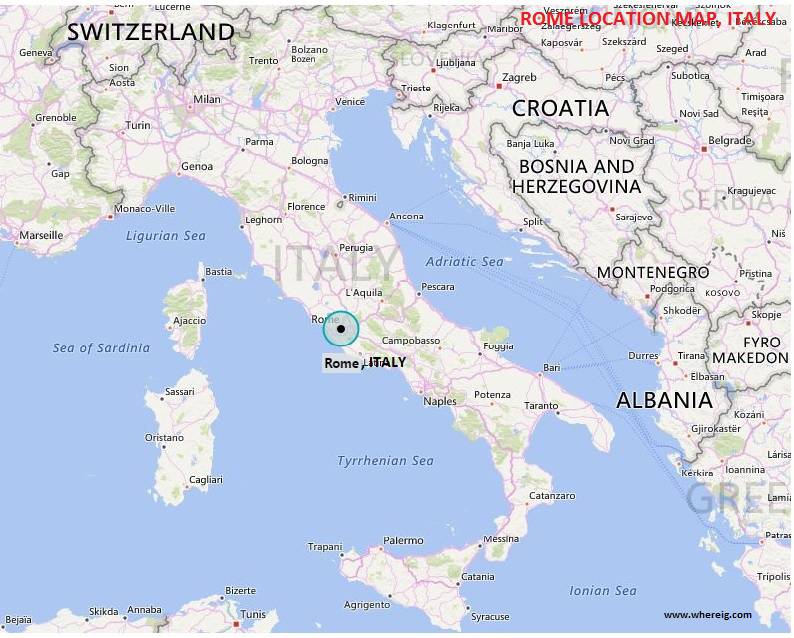
Rome is located on the Tiber River within the Lazio region in the central west of Peninsular Italy. Rome is the largest, most populated and capital city of Italy.
Location Map of Rome City Facts, Italy
About Map: The map showing location map of Rome in Italy.
Rome (in Italian: Roma) the capital of Italy. The city is located at the Tiber River in the central-western portion of the Italy, about 15 miles (23 km) east off the coast of the Mediterranean Sea. It is the third most populous city in the European Union. Rome is founded in the ancient time; hence, its architecture over the centuries has developed beautiful and fascinating design especially from the Classical and Imperial Roman styles to modern Fascist architecture. The Roman classical style fascinates tourists from all corners of this world.
Though, there is hardly any heavy industry in Rome but its economy largely depends upon services, high-technology companies specifically IT, aerospace, defense, telecommunications; other significant sectors are research, construction and commercial activities (especially banking), and tourism. Besides, Rome is also the hub of the Italian film industry.
Moreover, Rome's classical architectural beauties in the modern landscapes deceive thousands of tourists. Because of all these reasons, in the year 2019, Rome was the 11th-most-visited city in the world and 3rd most visited city in the European Union. The most interesting places in Rome are monuments, museums (Vatican Museums and Colosseum Museum) and other natural landscapes. Most of the historic centers of Rome are listed as World Heritage Site by UNESCO.
Rome, Lazio Quick Facts
Fact
Details
City
Rome (Roma)
Region
Lazio
Country
Italy
National Capital
Rome
Region
Central Italy
Latitude
41.9028° N
Longitude
12.4964° E
Elevation
69 ft (21 m)
Land Area
496 sq mi
Water Area
Includes the Tiber River and urban waterways
Total Area
496 sq mi
Population (Latest Estimate)
Approximately 2.8 million
Population Density
Approximately 5,650 per sq mi
Postal Codes
00118-00199
Area Code
+39 06
Time Zone Standard
Central European Time (UTC+1)
Time Zone Daylight
Central European Summer Time (UTC+2)
Currency
Euro (EUR)
Municipality Code
H501
National Representation
Multiple Italian Parliamentary Constituencies
Nearby Cities to Rome, Italy
Ciampino, Italy - 9 mi Southeast
Fiumicino, Italy - 19 mi Southwest
Tivoli, Italy - 19 mi East
Frascati, Italy - 13 mi Southeast
Pomezia, Italy - 21 mi South
Monterotondo, Italy - 16 mi Northeast
Anzio, Italy - 38 mi South
Latina, Italy - 43 mi Southeast
Viterbo, Italy - 50 mi Northwest
L'Aquila, Italy - 72 mi Northeast
Rome, Italy Climate and Weather Overview
Month
Avg High (°F)
Avg Low (°F)
Avg Rainfall (in)
January
55
39
3.2
April
66
47
2.8
July
89
66
0.8
October
73
56
4.5
Annual
72
53
31.0
Climate Attribute
Details
Climate Classification (Köppen)
Csa - Hot-Summer Mediterranean
Annual Rainfall
Approximately 31 inches
Annual Sunshine Days
Approximately 245 sunny days
Hurricane/Tornado Risk
Very Low
Snowfall
Rare and light snowfall
Driving Distances from Rome, Italy
City
Country
Distance (mi)
Approx. Drive Time
Ciampino
Italy
9
20 min
Frascati
Italy
13
25 min
Monterotondo
Italy
16
30 min
Fiumicino
Italy
19
30 min
Tivoli
Italy
19
35 min
Pomezia
Italy
21
35 min
Anzio
Italy
38
55 min
Latina
Italy
43
1 hr
Viterbo
Italy
50
1 hr 10 min
L'Aquila
Italy
72
1 hr 30 min
Transportation and Connectivity in Rome, Italy
Airport Name
Leonardo da Vinci International Airport (Fiumicino Airport)
IATA Code
FCO
Port
Port of Civitavecchia (nearby)
Major Highways
A1 Autostrada, A24, A91, Grande Raccordo Anulare (GRA)
Train Service
Trenitalia High-Speed Rail, Regional Rail and Intercity Services
Local Transit Service
Rome Metro, Trams, Buses and Urban Rail
A1 Autostrada - Italy's primary north-south motorway connecting Rome with Milan and Naples.
A24 - Connects Rome with Tivoli and the Abruzzo region.
A91 - Main expressway linking central Rome with Fiumicino Airport.
Grande Raccordo Anulare (GRA) - Ring road encircling the metropolitan area.
Via Appia - Historic route that remains an important transportation corridor.
Key Landmarks and Places to Visit in Rome, Italy
Landmark Name
Type
Colosseum
Historic Amphitheater
Roman Forum
Archaeological Site
Trevi Fountain
Historic Fountain
Pantheon
Historic Monument
St. Peter's Basilica
Religious Site
Vatican Museums
Museum
Spanish Steps
Historic Landmark
Piazza Navona
Public Square
Castel Sant'Angelo
Historic Fortress
Borghese Gallery
Art Museum
Places to Visit in Rome, Italy
Landmark Name
Type
Colosseum
Historic Amphitheater
Roman Forum
Archaeological Site
Trevi Fountain
Historic Fountain
Pantheon
Historic Monument
St. Peter's Basilica
Religious Site
Vatican Museums
Museum
Spanish Steps
Historic Landmark
Piazza Navona
Public Square
Castel Sant'Angelo
Historic Fortress
Borghese Gallery
Art Museum
Colleges and Universities in Rome, Italy
Institution Name
Type
Level
Notable For
Sapienza University of Rome
Public
University
Research and higher education
University of Rome Tor Vergata
Public
University
Science and technology
Roma Tre University
Public
University
Liberal arts and research
LUISS University
Private
University
Business and law
Pontifical Gregorian University
Private
University
Theological studies
Waterbodies in Rome, Italy
Tiber River, Aniene River, Lake Bracciano, Lake Albano, Lake Nemi, Acqua Claudia Aqueduct Waters, Ostia Coastline, Castel Giubileo Reservoir, Laghetto dell'EUR, Tevere Urban Waterways
Golf Courses in Rome, Italy
Marco Simone Golf & Country Club, Parco de' Medici Golf Club, Circolo del Golf Roma Acquasanta, Olgiata Golf Club, Golf Nazionale, Castelgandolfo Golf Club, Sheraton Golf Parco de' Medici, Fioranello Golf Club, Golf Club Arco di Costantino, Terre dei Consoli Golf Club
Rome, Italy - Key Historical Facts
According to tradition, Rome was founded in 753 BCE and became the center of one of history's greatest civilizations.
The city served as the capital of the Roman Empire, influencing law, architecture and governance across Europe and beyond.
Rome became a major center of Christianity and the seat of the Roman Catholic Church.
The Renaissance and Baroque periods transformed the city with iconic churches, palaces and public squares.
Rome became the capital of a unified Italy in 1871.
Today, Rome is one of the world's most visited cities and a leading center of culture, history and government.