
This is list of Middle East Countries and their Capitals, Currency, area, Population & official langiuage. Middle East comprises 18 countries: Akrotiri and Dhekelia, Bahrain, Cyprus, Egypt, Iran, Iraq, Israel, Jordan, Kuwait, Lebanon, Oman, Palestine, Qatar, Saudi Arabia, Syria, Turkey, United Arab Emirates, Yemen.
Middle East Countries Map
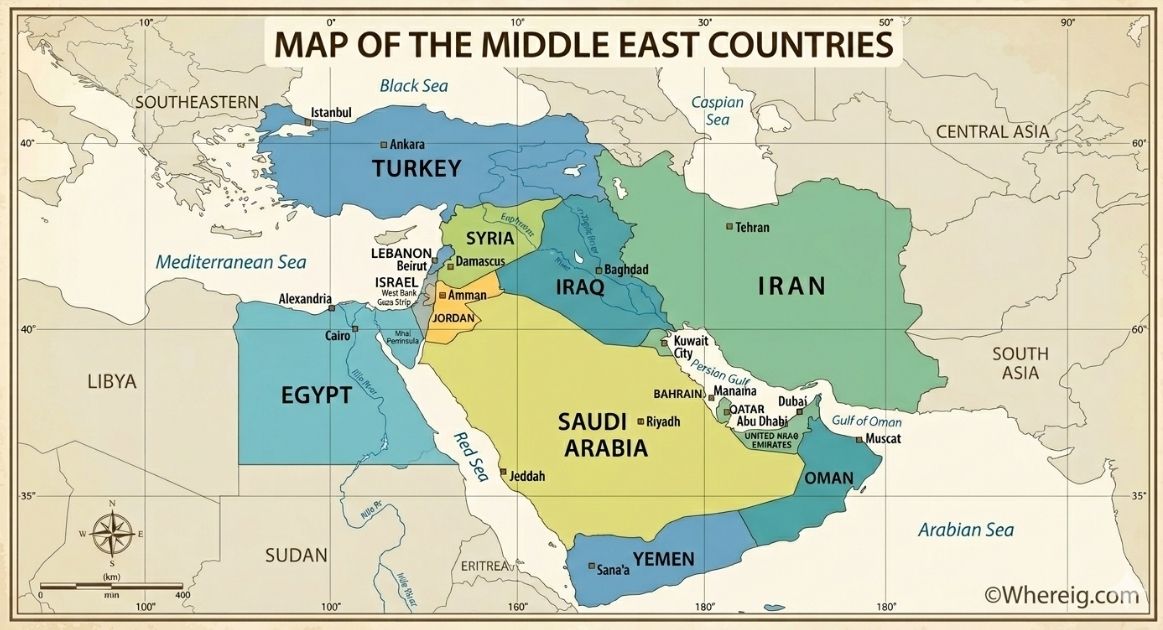
About Map: The map highlights the countries of the Middle East in Western Asia and North Africa, showing national boundaries, major cities, and their geographic location between Europe, Asia, and Africa.
Following is the list of Middle East Countries and their Capitals, Currency, area, Population & official langiuage. Sovereign states and dependencies by population. Middle East includes Iran (Persia), Asia Minor, Mesopotamia, the Levant, the Arabian Peninsula, and Egypt.
List of Middle East Countries
| Country | Capital | Currency | Official Language | Area (sq km) | Population (2023 est.) | Government |
|---|---|---|---|---|---|---|
| Akrotiri and Dhekelia | Episkopi Cantonment | Euro | English | 254 | 15,000 | British Overseas Territory |
| Bahrain | Manama | Bahraini Dinar | Arabic | 786 | 1,500,000 | Constitutional Monarchy |
| Cyprus | Nicosia | Euro | Greek, Turkish | 9,251 | 1,260,000 | Presidential Republic |
| Egypt | Cairo | Egyptian Pound | Arabic | 1,010,408 | 112,000,000 | Presidential Republic |
| Iran | Tehran | Iranian Rial | Persian | 1,648,195 | 89,000,000 | Islamic Republic |
| Iraq | Baghdad | Iraqi Dinar | Arabic, Kurdish | 438,317 | 45,000,000 | Federal Parliamentary Republic |
| Israel | Jerusalem | Israeli New Shekel | Hebrew | 22,072 | 9,800,000 | Parliamentary Republic |
| Jordan | Amman | Jordanian Dinar | Arabic | 89,342 | 11,300,000 | Constitutional Monarchy |
| Kuwait | Kuwait City | Kuwaiti Dinar | Arabic | 17,818 | 4,300,000 | Constitutional Monarchy |
| Lebanon | Beirut | Lebanese Pound | Arabic | 10,452 | 5,500,000 | Parliamentary Republic |
| Oman | Muscat | Omani Rial | Arabic | 309,500 | 4,600,000 | Absolute Monarchy |
| Palestine | Ramallah (administrative) | Israeli New Shekel | Arabic | 6,220 | 5,300,000 | Self-governing Authority |
| Qatar | Doha | Qatari Riyal | Arabic | 11,581 | 2,700,000 | Absolute Monarchy |
| Saudi Arabia | Riyadh | Saudi Riyal | Arabic | 2,149,690 | 36,000,000 | Absolute Monarchy |
| Syria | Damascus | Syrian Pound | Arabic | 185,180 | 23,000,000 | Presidential Republic |
| Turkey | Ankara | Turkish Lira | Turkish | 783,562 | 85,000,000 | Presidential Republic |
| United Arab Emirates | Abu Dhabi | UAE Dirham | Arabic | 83,600 | 9,500,000 | Federal Absolute Monarchy |
| Yemen | Sana’a | Yemeni Rial | Arabic | 527,968 | 34,000,000 | Republic |
Middle East Facts
| Region Name | Middle East |
| Geographic Location | Western Asia and parts of North Africa |
| Number of Countries | Approximately 17–18 (definition varies) |
| Total Area | Approximately 7.3 million sq km |
| Total Population (2023 est.) | Over 500 million |
| Major Seas | Arabian Sea, Mediterranean Sea, Red Sea, Persian Gulf |
| Major Rivers | Tigris, Euphrates, Nile (western part), Jordan River |
| Highest Point | Mount Damavand (Iran) – 5,610 m |
| Major Desert | Arabian Desert |
| Main Religions | Islam (majority), Christianity, Judaism |
| Dominant Language Family | Arabic (widely spoken), Persian, Turkish, Hebrew |
| Economic Base | Oil and natural gas, trade, finance, tourism |
| Major Oil Producers | Saudi Arabia, Iran, Iraq, UAE, Kuwait, Qatar |
| Climate | Predominantly desert and arid climate |
| Time Zones | Mainly UTC+2 to UTC+4 |
| Political Systems | Monarchies, Republics, Theocracies |
| Strategic Importance | Key global trade and energy supply region |
Middle East Countries FAQs
How many countries are in the Middle East?
The Middle East generally includes around 17 to 18 countries, depending on geographic and political definitions used by different organizations.
Which countries are included in the Middle East?
The Middle East commonly includes Bahrain, Cyprus, Egypt, Iran, Iraq, Israel, Jordan, Kuwait, Lebanon, Oman, Palestine, Qatar, Saudi Arabia, Syria, Turkey, United Arab Emirates, and Yemen.
Is the Middle East located in Asia or Europe?
The Middle East is primarily located in Western Asia, with Egypt extending into North Africa and Turkey spanning both Southeast Europe and Western Asia.
Why is the Middle East considered an important region?
The Middle East is important due to its strategic location connecting Asia, Africa, and Europe, its vast energy resources, and its historical significance as the birthplace of major civilizations.
Which is the largest country in the Middle East by land area?
Saudi Arabia is the largest country in the Middle East by land area, covering approximately 2.15 million square kilometers.
Which country has the highest population in the Middle East?
Egypt has the highest population in the Middle East, with a population exceeding 110 million people.
What languages are commonly spoken in the Middle East?
Arabic is the most widely spoken language, along with Persian, Turkish, Hebrew, and Kurdish, while English is commonly used as a second language.
What religions originated in the Middle East?
Judaism, Christianity, and Islam all originated in the Middle East, making the region highly significant in religious history.
Does the Middle East have deserts?
Yes, the Middle East is home to major deserts such as the Arabian Desert and the Syrian Desert, which shape much of the region’s climate.
Is the Middle East rich in natural resources?
The Middle East holds some of the world’s largest reserves of oil and natural gas, making it a key region in the global energy market.