
Explore the list of ancient civilizations of the world including Mesopotamia, Egypt, Indus Valley, China, Greece, Rome, Maya, and more. Discover their timeline, key features, major sites, and historical significance.
Ancient Civilizations Map
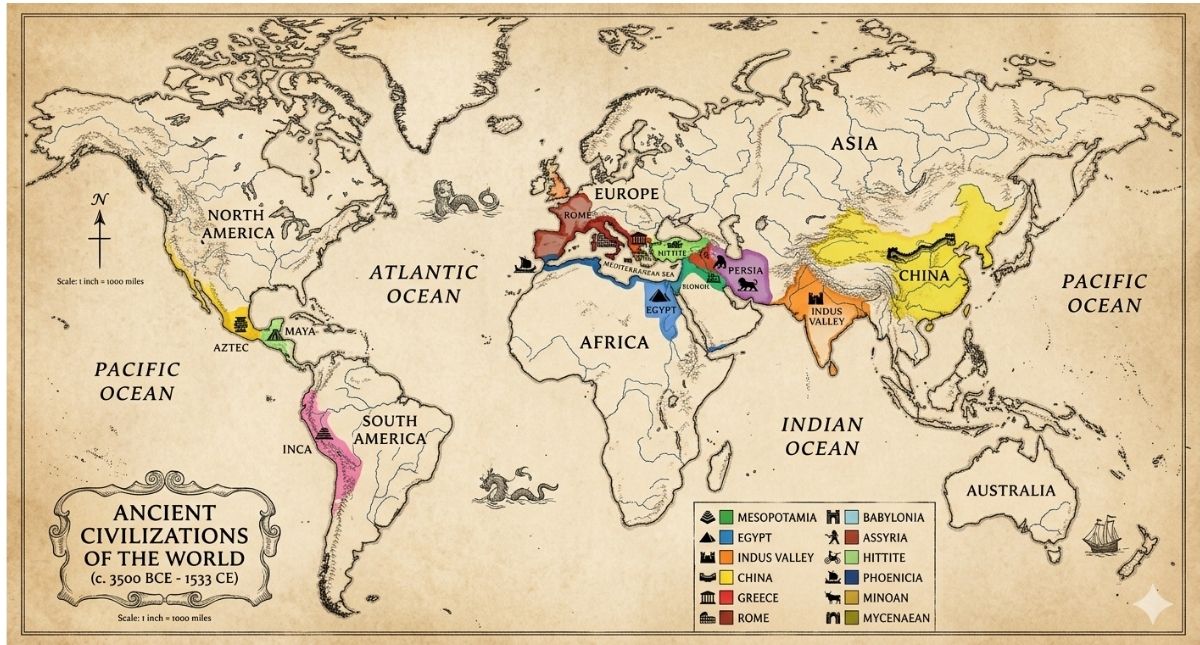
About Image: This map shows the geographical locations of major ancient civilizations including Mesopotamia, Egypt, the Indus Valley, China, Greece, Rome, and the civilizations of the Americas across different regions of the world.
Image Disclaimer (Click to expand)
This map is for informational and educational purposes only. The locations and boundaries shown are approximate and may not represent precise historical or geographical accuracy.
About Ancient Civilizations of the World
Long before modern countries and borders existed, some of the world’s earliest societies began forming near rivers and fertile lands. These early civilizations were not just settlements - they were organized communities that developed systems of writing, trade, governance, and culture. From Mesopotamia to the Indus Valley and ancient China, each civilization contributed ideas and innovations that still influence how we live today.
What are Ancient Civilizations?
Ancient civilizations are early human societies that developed organized systems of governance, culture, economy, and technology, typically near river valleys.
List of Ancient Civilizations of the World
| # | Civilization | Region | Timeline | Key Features | Famous Sites |
|---|---|---|---|---|---|
| 1 | Mesopotamian Civilization | West Asia (Iraq, Syria) | c. 3500 BCE – 539 BCE | First writing system (cuneiform), early cities and governance | Babylon, Ur |
| 2 | Ancient Egyptian Civilization | Nile River Valley (Egypt) | c. 3100 BCE – 30 BCE | Pyramids, hieroglyphics, strong centralized rule | Giza Pyramids |
| 3 | Indus Valley Civilization | South Asia (India, Pakistan) | c. 3300 BCE – 1300 BCE | Advanced urban planning, drainage systems ahead of their time | Harappa, Mohenjo-daro |
| 4 | Ancient Chinese Civilization | Yellow River Valley (China) | c. 2000 BCE onward | Early dynasties, invention of paper and silk production | Anyang |
| 5 | Ancient Greek Civilization | Europe (Greece) | c. 800 BCE – 146 BCE | Birthplace of democracy, philosophy, and Olympic Games | Athens, Sparta |
| 6 | Roman Civilization | Europe (Italy & Mediterranean) | c. 753 BCE – 476 CE | Legal systems, road networks, and large-scale engineering | Rome, Colosseum |
| 7 | Persian Civilization | Middle East (Iran) | c. 550 BCE – 330 BCE | One of the largest empires, efficient administration | Persepolis |
| 8 | Mayan Civilization | Central America | c. 2000 BCE – 1500 CE | Accurate calendar system, astronomy, step pyramids | Chichen Itza |
| 9 | Aztec Civilization | Mexico | c. 1300 CE – 1521 CE | Powerful military, advanced capital city planning | Tenochtitlan |
| 10 | Inca Civilization | South America (Andes) | c. 1400 CE – 1533 CE | Extensive road networks, mountain engineering | Machu Picchu |
| 11 | Babylonian Civilization | Mesopotamia | c. 1894 BCE – 539 BCE | Code of Hammurabi, early legal system | Babylon |
| 12 | Assyrian Civilization | Northern Mesopotamia | c. 2500 BCE – 609 BCE | Military strength and expansion strategies | Nineveh |
| 13 | Hittite Civilization | Anatolia (Turkey) | c. 1600 BCE – 1178 BCE | Iron usage and early diplomatic treaties | Hattusa |
| 14 | Phoenician Civilization | Levant (Lebanon) | c. 1500 BCE – 300 BCE | Alphabet development and maritime trade | Tyre, Sidon |
| 15 | Minoan Civilization | Crete (Greece) | c. 2600 BCE – 1100 BCE | Early European culture and palace systems | Knossos |
| 16 | Mycenaean Civilization | Greece | c. 1600 BCE – 1100 BCE | Warrior society and early Greek influence | Mycenae |
Oldest Civilization in the World
The Sumerians, part of the larger Mesopotamian region, are widely considered the earliest known civilization. Emerging around 4500 BCE, they introduced one of the first writing systems and built some of the world’s earliest cities, setting the stage for organized society.
Key Features of Ancient Civilizations
- Development of structured cities and urban life
- Systems of governance and administration
- Creation of writing for communication and records
- Advancements in architecture and engineering
- Trade networks connecting different regions
- Cultural and religious practices shaping societies
Timeline of Ancient Civilizations
The earliest civilizations began appearing around 3500 BCE in Mesopotamia and Egypt. Over time, similar societies developed in the Indus Valley and China. Later, classical civilizations such as Greece and Rome expanded cultural and political systems, while civilizations in the Americas, including the Maya, Aztec, and Inca, evolved independently with their own unique achievements.
Map of Ancient Civilizations
Most ancient civilizations developed near rivers and fertile regions that supported agriculture and trade. Important locations include the Nile River in Egypt, the Tigris-Euphrates in Mesopotamia, the Indus River in South Asia, and the Yellow River in China, along with regions in Mesoamerica and the Andes.
FAQs About Ancient Civilizations
What are the four major ancient civilizations?
The four major early civilizations are Mesopotamian, Egyptian, Indus Valley, and Chinese. These are often called river valley civilizations because they developed near major rivers.
Why did ancient civilizations develop near rivers?
Rivers provided water, fertile soil for farming, and easy transportation routes, making them ideal locations for early human settlements to grow.
Which is the oldest civilization in the world?
The Sumerians are generally considered the oldest known civilization, dating back to around 4500 BCE.
What made ancient civilizations important?
They introduced key concepts such as writing, governance, trade systems, and cultural practices that continue to shape modern societies.
Ancient Civilizations of the World Facts
| Category | Details |
|---|---|
| Definition of Civilizations | Early human societies with organized systems of governance, culture, economy, and technology |
| Time Period | c. 3500 BCE to 1500 CE (varies by region) |
| Oldest Civilization | Sumerian Civilization (Mesopotamia) |
| Major Civilizations | Mesopotamian, Egyptian, Indus Valley, Chinese, Greek, Roman, Persian, Maya, Aztec, Inca |
| Primary Regions | Asia, Africa, Europe, and the Americas |
| Key River Valleys | Tigris-Euphrates, Nile, Indus, Yellow River |
| Main Features | Urban settlements, writing systems, governance, trade networks, cultural development |
| Writing Systems | Cuneiform, Hieroglyphics, Early Scripts, Alphabets |
| Major Contributions | Architecture, law, mathematics, astronomy, agriculture, trade systems |
| Famous Sites | Pyramids of Giza, Babylon, Mohenjo-daro, Great Wall region, Machu Picchu |
| Economic Activities | Agriculture, trade, craftsmanship, taxation |
| Religious Beliefs | Polytheism, rituals, temples, afterlife beliefs |
| Decline Factors | Wars, environmental changes, invasions, economic decline |
| Historical Importance | Foundation of modern society including governance, culture, and technology |
| Modern Relevance | Influences current law, architecture, science, and cultural systems |
| Related Topics | World History, Early Human Societies, Archaeology, Ancient Cultures |
| Common Study Areas | History, Archaeology, Anthropology |
| Official Source | UNESCO World Heritage Centre |