
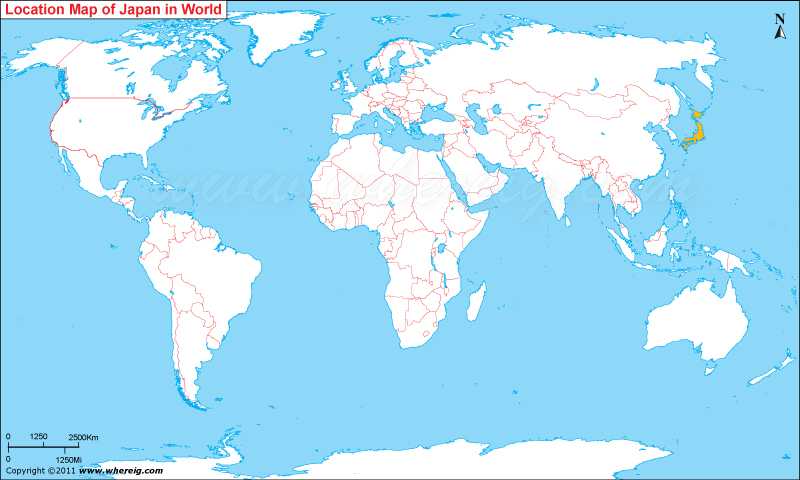
Japan is an island nation in East Asia, located in the Pacific Ocean, it lies to the east of the Sea of Japan, North Korea, China, South Korea and Russia, stretching from the Sea of Okhotsk in the north to the East China Sea and Taiwan in the south.
Location Map of Japan
Most Viewed Links
Where is Japan Located?
Japan is located in the far east of Asia continent. It is a group of islands nation located in the Pacific Ocean. Japan Sea lies east of Japan that separates from Russia, China and Korean Peninsula. In the south east China Sea lies. In north, La Perouse Strait separates Japan from Sakhalin, Russia and Korea Strait separates Japan from South Korea in the south west. Interestingly, Japan name is not given randomly rather it has some meaning i.e. "sun-origin". This is why Japan has sobriquet i.e. "Land of the Rising Sun".
Surprisingly, Japan is an archipelago of about 6,850 islands. However, among them four are the largest main islands that constitute about the 97% part of the country i.e. Honshu, Hokkaido, Kyushu, and Shikoku. Most of the islands of Japan have mountainous terrain and there are many volcanic mountain peaks. The highest mountain peak of Japan is Mount Fuji, which is a volcanic peak.
Though, in terms of area, Japan is quite small but in terms of population Japan is the world's tenth-largest populated country with more than 127 million people. The Greater Tokyo region, which is the capital city of Japan incorporates some the peripheral area and together constitutes world's largest metropolitan area. Japan has maintained a unitary constitutional monarchy with an emperor and an elected parliament called the Diet.
Japan has the world's third-largest economy in terms of purchasing power parity. Not only this, Japan is also the world's fifth largest importer and fourth largest exporter. Though, Japan willingly gave up its right to declare a war; nevertheless, it has quite modern and extensive military force for self-defense and peacekeeping purpose. As per WHO report Japan has the highest life expectancy and the third lowest infant mortality rate in the world.
Since more than 80 percent of Japan is mountainous; hence it is unsuitable for agricultural, industrial, or even residential use. Besides, the islands of Japan are located in a volcanic zone on the Pacific Ring of Fire. There are steep elevations, diverse climate and high risk of landslides more often induced by earthquakes and heavy rain. Probably, this the reason that the habitable zones mainly concentrated in coastal areas, where population density is very high.
Prefectures of Japan
| Prefecture | Capital | Population | Area | Latitude and Longitude |
|---|---|---|---|---|
| Tokyo | Tokyo | 14 million+ | 2,194 sq km (847 sq mi) | 35.6762° N, 139.6503° E |
| Osaka | Osaka | 8.8 million+ | 1,905 sq km (735 sq mi) | 34.6937° N, 135.5023° E |
| Kanagawa | Yokohama | 9.2 million+ | 2,416 sq km (933 sq mi) | 35.4478° N, 139.6425° E |
| Aichi | Nagoya | 7.5 million+ | 5,173 sq km (1,997 sq mi) | 35.1815° N, 136.9066° E |
| Hokkaido | Sapporo | 5.1 million+ | 83,424 sq km (32,210 sq mi) | 43.0618° N, 141.3545° E |
| Fukuoka | Fukuoka | 5.1 million+ | 4,986 sq km (1,925 sq mi) | 33.5904° N, 130.4017° E |
| Hyogo | Kobe | 5.4 million+ | 8,400 sq km (3,243 sq mi) | 34.6901° N, 135.1955° E |
| Kyoto | Kyoto | 2.5 million+ | 4,613 sq km (1,781 sq mi) | 35.0116° N, 135.7681° E |
| Okinawa | Naha | 1.5 million+ | 2,281 sq km (881 sq mi) | 26.2124° N, 127.6809° E |
| Hiroshima | Hiroshima | 2.8 million+ | 8,479 sq km (3,274 sq mi) | 34.3853° N, 132.4553° E |
10 Largest Cities in Japan
| City | Prefecture | Population | Latitude and Longitude |
|---|---|---|---|
| Tokyo | Tokyo | 14 million+ | 35.6762° N, 139.6503° E |
| Yokohama | Kanagawa | 3.7 million+ | 35.4478° N, 139.6425° E |
| Osaka | Osaka | 2.7 million+ | 34.6937° N, 135.5023° E |
| Nagoya | Aichi | 2.3 million+ | 35.1815° N, 136.9066° E |
| Sapporo | Hokkaido | 1.9 million+ | 43.0618° N, 141.3545° E |
| Fukuoka | Fukuoka | 1.6 million+ | 33.5904° N, 130.4017° E |
| Kobe | Hyogo | 1.5 million+ | 34.6901° N, 135.1955° E |
| Kyoto | Kyoto | 1.4 million+ | 35.0116° N, 135.7681° E |
| Kawasaki | Kanagawa | 1.5 million+ | 35.5308° N, 139.7036° E |
| Hiroshima | Hiroshima | 1.2 million+ | 34.3853° N, 132.4553° E |
Top Tourist Attractions and Famous Places to Visit in Japan
- Mount Fuji - Shizuoka/Yamanashi
- Fushimi Inari Shrine - Kyoto
- Tokyo Skytree - Tokyo
- Himeji Castle - Hyogo
- Senso-ji Temple - Tokyo
- Arashiyama Bamboo Grove - Kyoto
- Hiroshima Peace Memorial Park - Hiroshima
- Shibuya Crossing - Tokyo
- Osaka Castle - Osaka
- Nara Park - Nara
- Itsukushima Shrine - Miyajima
- Okinawa Beaches - Okinawa
- Jigokudani Monkey Park - Nagano
- Nikko Toshogu Shrine - Tochigi
- Sapporo Snow Festival - Hokkaido
- Universal Studios Japan - Osaka
Japan Facts
| Continent | Asia |
| Country | Japan |
| Capital | Tokyo |
| Largest City | Tokyo |
| Coordinates | 36.2048° N, 138.2529° E |
| Administrative Divisions | 47 Prefectures |
| Official Languages | Japanese |
| Demonym | Japanese |
| Government | Unitary Parliamentary Constitutional Monarchy |
| Independence | Traditional founding 660 BC |
| Total Area | 377,975 sq km (145,937 sq mi) |
| Population | 123 million+ (2025 est.) |
| Population Density | 325 people per sq km |
| Currency | Japanese Yen (JPY) |
| GDP Nominal | Approx. USD 4.2 trillion |
| Economy | Advanced High-Income Economy |
| Postal Code Format | ###-#### |
| Country Calling Code | +81 |
| Time Zone | JST (UTC+9) |
| Internet TLD | .jp |
| ISO Country Code | JP |
| Driving Side | Left |
| Major Cities | Tokyo, Yokohama, Osaka, Nagoya, Sapporo |
| Major Airports | Tokyo Haneda Airport, Narita International Airport, Kansai International Airport |
| Highest Point | Mount Fuji (3,776 m) |
| Longest River | Shinano River |
| Climate | Temperate and Subtropical Climate |
| Average Summer Temperature | 22°C to 32°C |
| Average Winter Temperature | -5°C to 10°C |
| Famous For | Technology, Anime, Temples, Cuisine, Cherry Blossoms |
| National Animal | Japanese Macaque |
| National Sport | Sumo Wrestling |
| National Dish | Sushi |
| Official Website | japan.go.jp |
Major Rivers in Japan
- Shinano River
- Tone River
- Ishikari River
- Kiso River
- Kitakami River
- Yodo River
- Tenryu River
- Agano River
Japan Climate Facts
| Climate Type | Temperate, Humid Subtropical, and Continental |
| Summer Temperature | 22°C to 32°C |
| Winter Temperature | -5°C to 10°C |
| Average Rainfall | 1,000 mm to 2,500 mm annually depending on region |
Neighboring Countries of Japan
- Russia - North
- South Korea - West
- North Korea - West
- China - Southwest
References
- Official Government Website
- Statistics Bureau of Japan
- World Bank
- CIA World Factbook
- United Nations Population Division
- Where is Tokyo
- Where is Ageo
- Where is Akashi
- Where is Akita
- Where is Amagasaki
- Where is Aomori
- Where is Asahikawa
- Where is Atsugi
- Where is Chiba
- Where is Chigasaki
- Where is Chofu
- Where is Fuchu
- Where is Fuji
- Where is Fujisawa
- Where is Fukui
- Where is Fukuoka
- Where is Fukushima
- Where is Fukuyama
- Where is Funabashi
- Where is Gifu
- Where is Hachinohe
- Where is Hachioji
- Where is Hakodate
- Where is Hamamatsu
- Where is Himeji
- Where is Hirakata
- Where is Hiratsuka
- Where is Hiroshima
- Where is Ibaraki
- Where is Ichihara
- Where is Ichikawa
- Where is Ichinomiya
- Where is Iwaki
- Where is Kagoshima
- Where is Kakogawa
- Where is Kanazawa
- Where is Kashiwa
- Where is Kasugai
- Where is Kasukabe
- Where is Kawagoe
- Where is Kawaguchi
- Where is Kawasaki
- Where is Kitakyushu
- Where is Kobe
- Where is Kochi
- Where is Koriyama
- Where is Koshigaya
- Where is Kumamoto
- Where is Kurashiki
- Where is Kurume
- Where is Kyoto
- Where is Machida
- Where is Maebashi
- Where is Matsudo
- Where is Matsumoto
- Where is Minami Rinkan
- Where is Mito
- Where is Miyazaki
- Where is Morioka
- Where is Nagano
- Where is Nagasaki
- Where is Nagoya
- Where is Naha
- Where is Nara
- Where is Nerima
- Where is Niigata
- Where is Nishinomiya
- Where is Oita
- Where is Okayama
- Where is Okazaki
- Where is Osaka
- Where is Otsu
- Where is Sagamihara
- Where is Sakai
- Where is Sapporo
- Where is Sasebo
- Where is Sendai
- Where is Shimminatocho
- Where is Shimonoseki
- Where is Shizuoka
- Where is Soka
- Where is Suita
- Where is Takamatsu
- Where is Takarazuka
- Where is Takasaki
- Where is Takatsuki
- Where is Tokorozawa
- Where is Tokushima
- Where is Toyama
- Where is Toyohashi
- Where is Toyonaka
- Where is Toyota
- Where is Utsunomiya
- Where is Wakayama
- Where is Yamagata
- Where is Yao
- Where is Yokkaichi
- Where is Yokohama
- Where is Yokosuka
- Where is Yono