Written and Fact-checked by Whereig Editors | Updated On: June 12, 2026, 15:05 ET
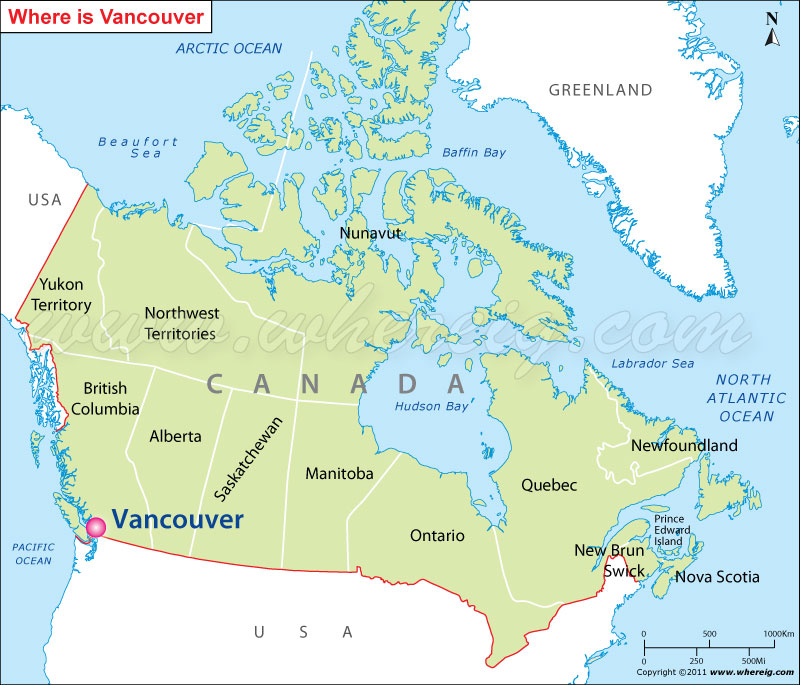
Vancouver is a seaport city is located in Western Canada, on the Pacific coast, in the province of British Columbia.
Vancouver Location Map
About Map: Map showing Location of Vancouver in the Canada Map
Where is Vancouver Located?
Vancouver City is located in the Lower Mainland of British Columbia, West Canada. The city has coastal location at Eastern Pacific Ocean. The city was first time explored by the British Captain George Vancouver, and hence the name of city has been given after explorer's name.
Along with the metropolitan area, Vancouver is the third-largest city in Canada. The city is the largest and most populous city in the south-western Canada. In 1886, the city has been incorporated and in the passage of time it has experienced tremendous growth. The evolution of railways and sea-port in the city has changed the scenario of Vancouver.
So, the economy of the city depends upon the various sectors including forestry, tourism, software development, biotechnology etc. In addition, Vancouver is the third largest film production center in entire North America; the other two are - first one is Los Angeles and second one is New York City. In terms of most livable city, Vancouver has good position. The city remains center for the many events and international games.
One of the most ethnically diverse cities in Canada
Official Languages
English (Primary), Large Cantonese & Punjabi speaking communities
Known For
Tourism, Film Industry ("Hollywood North"), Seaport, Mountains, Coastline
GDP (Metro Vancouver)
Approx. CAD $140+ Billion
Major Universities
University of British Columbia (UBC), Simon Fraser University (SFU)
Transportation System
SkyTrain, SeaBus, RapidBus, BC Ferries nearby
Sports Teams
Vancouver Canucks (NHL), Vancouver Whitecaps FC (MLS), BC Lions (CFL)
Elevation
0–152 m (0–499 ft)
Official Website
https://vancouver.ca/
Location
Vancouver is located on the southwestern coast of British Columbia between Burrard Inlet and the Fraser River. It lies north of the Canada-United States border and is surrounded by the Coast Mountains, the Pacific Ocean, and neighboring municipalities within Metro Vancouver. The city is known for its spectacular natural scenery, major seaport, diverse population, and strong economy driven by trade, technology, tourism, and film production.
Nearby Cities to Vancouver, British Columbia
Burnaby, British Columbia - 6 mi East
Richmond, British Columbia - 8 mi South
North Vancouver, British Columbia - 5 mi North
West Vancouver, British Columbia - 8 mi Northwest
New Westminster, British Columbia - 10 mi Southeast
Coquitlam, British Columbia - 16 mi East
Surrey, British Columbia - 20 mi Southeast
Delta, British Columbia - 18 mi South
Port Moody, British Columbia - 15 mi East
Langley, British Columbia - 28 mi Southeast
Vancouver, British Columbia Climate and Weather
Month
Avg High (°F)
Avg Low (°F)
Avg Rainfall (in)
January
44
36
6.6
April
56
42
2.8
July
73
56
1.4
October
58
47
4.8
Annual
58
46
47.0
Climate Attribute
Details
Climate Classification (Köppen)
Oceanic (Cfb)
Annual Rainfall
About 47 inches
Annual Sunshine Days
Approximately 290 days with measurable sunshine
Severe Weather Risk
Occasional windstorms and heavy rainfall events
Snowfall
Approximately 15 inches annually
Driving Distances from Vancouver, British Columbia
City
Province
Distance (mi)
Approx. Drive Time
North Vancouver
British Columbia
5
15 min
Burnaby
British Columbia
6
15 min
Richmond
British Columbia
8
20 min
West Vancouver
British Columbia
8
20 min
New Westminster
British Columbia
10
20 min
Port Moody
British Columbia
15
25 min
Coquitlam
British Columbia
16
30 min
Delta
British Columbia
18
30 min
Surrey
British Columbia
20
35 min
Langley
British Columbia
28
45 min
Distance from Vancouver to Other Canadian Cities
Victoria, BC - 115 km (71 mi)
Kelowna, BC - 390 km (242 mi)
Kamloops, BC - 355 km (220 mi)
Calgary, Alberta - 970 km (602 mi)
Edmonton, Alberta - 1,160 km (720 mi)
Regina, Saskatchewan - 1,740 km (1,081 mi)
Saskatoon, Saskatchewan - 1,575 km (979 mi)
Winnipeg, Manitoba - 2,300 km (1,429 mi)
Toronto, Ontario - 4,400 km (2,736 mi)
Ottawa, Ontario - 4,500 km (2,796 mi)
Montreal, Quebec - 4,600 km (2,858 mi)
Quebec City, Quebec - 4,850 km (3,014 mi)
Halifax, Nova Scotia - 6,000 km (3,728 mi)
St. John’s, Newfoundland - 7,500 km (4,660 mi)
Transportation in Vancouver, British Columbia
Category
Details
Airport Name
Vancouver International Airport
IATA Code
YVR
Port
Port of Vancouver
Major Highways
Trans-Canada Highway (BC 1), BC 99, BC 7, Knight Street, Granville Street
Train Service
VIA Rail, Amtrak Cascades, SkyTrain, West Coast Express
Local Transit Service
TransLink
Trans-Canada Highway (BC 1) - Primary east-west route connecting Vancouver with the rest of Canada.
Highway 99 - Major corridor linking downtown Vancouver with Richmond, Whistler, and the U.S. border.
Highway 7 - Connects the city with eastern Metro Vancouver communities.
Knight Street Bridge Corridor - Important freight and commuter route.
Granville Street - Key north-south urban transportation artery.
Lions Gate Bridge - Iconic connection between Vancouver and the North Shore.
Places to Visit in Vancouver, British Columbia
Landmark Name
Type
Stanley Park
Urban Park
Granville Island
Cultural District
Canada Place
Waterfront Landmark
Vancouver Aquarium
Aquarium
Capilano Suspension Bridge
Tourist Attraction
Gastown
Historic District
Vancouver Art Gallery
Museum
Science World
Science Museum
Queen Elizabeth Park
Urban Park
English Bay
Waterfront Attraction
Waterbodies in Vancouver, British Columbia
Pacific Ocean, Burrard Inlet, English Bay, False Creek, Fraser River, Georgia Strait, Coal Harbour, Lost Lagoon, Trout Lake, Capilano River
Golf Courses in Vancouver, British Columbia
University Golf Club, Fraserview Golf Course, McCleery Golf Course, Langara Golf Course, Point Grey Golf and Country Club, Marine Drive Golf Club, Shaughnessy Golf and Country Club, Musqueam Golf and Learning Academy, Northlands Golf Course, Riverway Golf Course
Economy in Vancouver, British Columbia
Sector
Major Employer or Industry
Notes
Trade and Shipping
Port of Vancouver
Canada's largest port.
Technology
Software and Digital Media Firms
Rapidly growing innovation sector.
Film and Television
Motion Picture Industry
Known as "Hollywood North".
Tourism
Hospitality and Attractions
Major contributor to the local economy.
Healthcare
Vancouver Coastal Health
Large healthcare employer.
Education
University of British Columbia
World-renowned educational institution.
Finance
Banking and Professional Services
Important regional economic sector.
Construction
Real Estate and Development
Supports metropolitan growth.
Colleges and Schools in Vancouver, British Columbia
Institution Name
Type
Level
Notable For
University of British Columbia
Public
University
Leading global research university
Simon Fraser University
Public
University
Comprehensive research institution
Emily Carr University of Art + Design
Public
University
Art and design education
Vancouver Community College
Public
College
Career and technical programs
British Columbia Institute of Technology
Public
College
Applied technology education
Vancouver School Board
Public
K-12 District
One of Canada's largest school districts
Vancouver, British Columbia - Key Historical Facts
Vancouver was incorporated in 1886 shortly after the arrival of the Canadian Pacific Railway.
The city grew rapidly as a transportation and trade gateway on Canada's Pacific Coast.
The Port of Vancouver became a major hub for international commerce and shipping.
Immigration from around the world helped shape Vancouver into one of Canada's most diverse cities.
The city gained international recognition by hosting the 2010 Winter Olympic Games.
Today, Vancouver is one of North America's leading centers for trade, technology, tourism, and film production.