
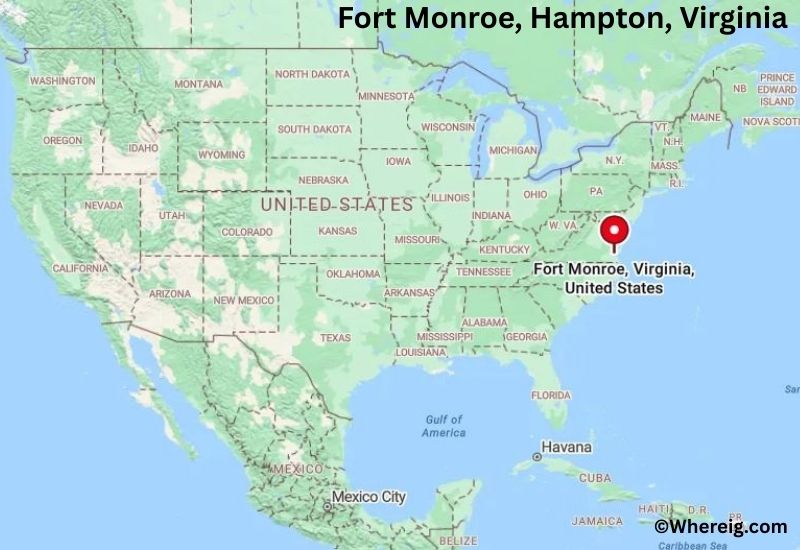
Fort Monroe is located in Hampton, Virginia, USA. It lies between the Chesapeake Bay and the James River and is situated in a coastal area. It is famous for being a historic military fort and for its role in the Civil War.
Fort Monroe Location Map, Hampton, Virginia
Virginia Maps and Info
Top Attractions Inside Fort Monroe
- Historic Fort Walls – Massive stone fortifications with a rich history dating back to the 19th century.
- Casemates Museum – Exhibits on military history, Civil War events, and life at the fort.
- Casemates & Bastions – Walkable interior spaces showing artillery placements and defensive architecture.
- Point Comfort Lighthouse – Historic lighthouse offering scenic views of the Chesapeake Bay.
- Beach & Waterfront Areas – Adjacent sandy beaches and walking paths along the bay.
- Guided Tours & Educational Programs – Informative tours covering the fort’s history, architecture, and role in American military heritage.
- Picnic & Recreation Spots – Open spaces for outdoor activities and enjoying bayfront scenery.
Fort Monroe Facts
| Official Name | Fort Monroe |
| Location | Old Point Comfort peninsula, Hampton, Virginia, USA |
| Latitude & Longitude | ≈ 37.0013° N, 76.3075° W |
| Total Area | 565 acres (fort + surrounding peninsula & lands) (original moated fortress 63 acres) |
| Construction Began / Built | Construction started 1819; main masonry fortress completed by 1834 |
| Named After | Likely named in honor of President James Monroe (or from “Point Monroe/Old Point Comfort” naming tradition) |
| Managed By / Current Status | Fort Monroe Authority & National Park Service — designated as a National Monument in 2011 |
| Region / Strategic Position | Tip of Virginia Peninsula, guarding entrance to Chesapeake Bay / Hampton Roads — strategic coastal defense |
| Address / Contact | 41 Bernard Road, Building #17, Fort Monroe, VA 23651‑1001, USA |
| Time Zone | Eastern Time (ET) — UTC−5 Standard / UTC−4 Daylight Saving |
| Fort Type / Concept | 19th‑century masonry coastal fortress (Third System coastal defense), moat‑surrounded casemate fortification with bastions & gun batteries |
| Structure & Features | Seven‑front fortress with bastions, thick masonry walls, casemates (for up to 400+ artillery pieces), wet moat, ramparts; includes historic buildings, lighthouse (oldest permanent structure), casemate museum, waterfront, beaches, wetlands & natural lands |
| Historical Significance | Largest stone fortification built in the U.S.; played crucial role in coastal defense, served through War of 1812 aftermath, Civil War, WWI/WWII, and modern era; key role in American slavery / emancipation history — site of 1619 arrival of first enslaved Africans in English North America & later refuge for escaped slaves (“Contraband Decision”) |
| Notable Historical Roles | Coastal defense; training site for U.S. Army coastal artillery & schools; Union stronghold during Civil War; refuge for escaped slaves; imprisonment site for former Confederate President Jefferson Davis (1865–1867); continuous U.S. Army installation until 2011 |
| Decommissioned / National Monument Designation | Deactivated as Army post September 15, 2011; designated a National Monument November 1, 2011 by presidential proclamation |
| Current Use / Offerings | Historic monument & public park — museum (Casemate Museum), historic tours, beaches & waterfront, walking trails, nature & bird‑watching, cultural events, education & memorials (including 1619 African Landing Memorial) |
| Natural / Environmental Features | Coastal wetlands, salt marshes, beaches, 8 miles waterfront, wetlands & submerged lands, live oak trees (including centuries‑old oaks), diverse bird & wildlife habitat |
| Cultural / Social Importance | Important symbol of African American history & emancipation — arrival of first enslaved Africans (1619) and refuge for escaped slaves during Civil War; designated as a “Slave Route Site of Memory” by UNESCO in 2021 |
| Official Website / Info Source | https://www.nps.gov/fomr/ (Fort Monroe National Monument) |
Distances from Fort Monroe to Nearby Landmarks
- Old Point Comfort Lighthouse – 0.1 km (0.1 mi)
- Fort Wool (Rip Raps island) – 1.6 km (1 mi)
- Buckroe Beach – 5 km (3 mi)
- Hampton, Virginia (city center) – 4.5 km (2.8 mi)
- Virginia Air & Space Center – 7 km (4.3 mi)
- Norfolk, Virginia – 27 km (16.5 mi)
- Virginia Beach, Virginia – 48 km (30 mi)
- Newport News, Virginia – 32 km (20 mi)
- Jamestown, Virginia (Historic Site) – 65 km (40 mi)
- Yorktown, Virginia (Historic Site) – 50 km (31 mi)
Top Places to Visit in Virginia
Explore the most popular tourist places in Virginia. The list below includes famous national parks, historic sites, and scenic attractions across the state, along with map locations.
Explore the complete list of places to visit in the United States, including national parks, cities, landmarks, and famous attractions.