
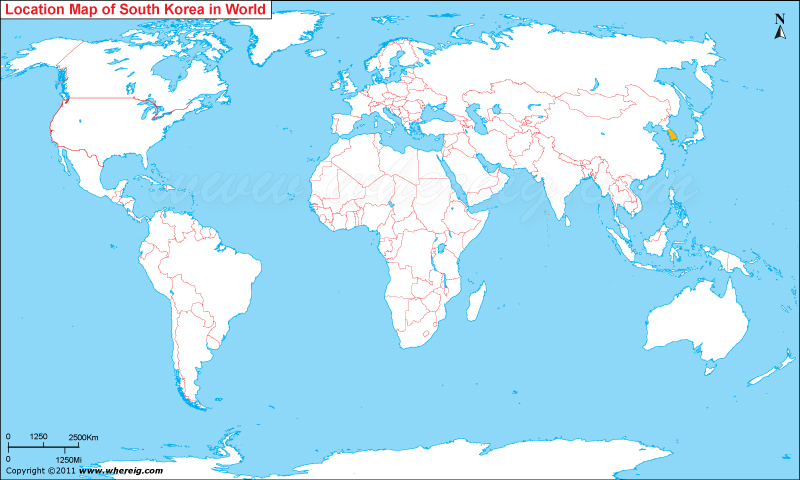
Map showing Where is South Korea located on the world map.
Pretty familiar and developed country always remains in news due to its political importance and development. South Korea is eastern Asian country located south of North Korea, east of China, and west of Japan on the southern portion of the Korean Peninsula. The capital city of South Korea is the Seoul.
Government system of South Korea is a presidential republic, which consists of sixteen administrative divisions. The country infrastructure, technology, education system, and economy are very developed and hence, country has high standard of living. Some of the world-wide recognized technologies and industries in South Korea are automobiles, electronics, machinery, ships, petrochemicals and robotics. It is a founding member of APEC and the East Asia Summit. Besides, South Korea is also member may international organizations such as the United Nations, WTO, OECD and G-20 etc.
Mountainous peninsula of South Korea is flanked by the Sea of Japan (East Sea) from east and Yellow Sea from the west. However, in the South Korea Strait separates it from the other islands.
Since, South Korea flanked largely with water bodies, hence it has humid subtropical climate and humid continental; precipitation is higher in summer during a short rainy season called jangma. A winter is generally extremely cold with the minimum temperature measuring below -20 °C in the inland region of the country.
In addition, South Korea has some of the very much important and beautiful sites where tourists of the world prefer to visit. For the South Korea tourism, government is also keen. Some of the important sites of South Korea are natural landscapes, museums, national park, and religious sites, largest and capital city Seoul.
Where is South Korea Located?
Pretty familiar and developed country always remains in news due to its political importance and development. South Korea is eastern Asian country located south of North Korea, east of China, and west of Japan on the southern portion of the Korean Peninsula. The capital city of South Korea is the Seoul.
Government system of South Korea is a presidential republic, which consists of sixteen administrative divisions. The country infrastructure, technology, education system, and economy are very developed and hence, country has high standard of living. Some of the world-wide recognized technologies and industries in South Korea are automobiles, electronics, machinery, ships, petrochemicals and robotics. It is a founding member of APEC and the East Asia Summit. Besides, South Korea is also member may international organizations such as the United Nations, WTO, OECD and G-20 etc.
Mountainous peninsula of South Korea is flanked by the Sea of Japan (East Sea) from east and Yellow Sea from the west. However, in the South Korea Strait separates it from the other islands.
Since, South Korea flanked largely with water bodies, hence it has humid subtropical climate and humid continental; precipitation is higher in summer during a short rainy season called jangma. A winter is generally extremely cold with the minimum temperature measuring below -20 °C in the inland region of the country.
In addition, South Korea has some of the very much important and beautiful sites where tourists of the world prefer to visit. For the South Korea tourism, government is also keen. Some of the important sites of South Korea are natural landscapes, museums, national park, and religious sites, largest and capital city Seoul.
Provinces and Metropolitan Cities of South Korea
| Division | Capital | Population | Area | Latitude and Longitude |
|---|---|---|---|---|
| Seoul Special City | Seoul | 9.3 million (2024 est.) | 605 sq km (234 sq mi) | 37.5665° N, 126.9780° E |
| Busan Metropolitan City | Busan | 3.3 million (2024 est.) | 770 sq km (297 sq mi) | 35.1796° N, 129.0756° E |
| Daegu Metropolitan City | Daegu | 2.3 million (2024 est.) | 883 sq km (341 sq mi) | 35.8714° N, 128.6014° E |
| Incheon Metropolitan City | Incheon | 3 million (2024 est.) | 1,066 sq km (412 sq mi) | 37.4563° N, 126.7052° E |
| Gwangju Metropolitan City | Gwangju | 1.4 million (2024 est.) | 501 sq km (193 sq mi) | 35.1595° N, 126.8526° E |
| Daejeon Metropolitan City | Daejeon | 1.4 million (2024 est.) | 540 sq km (208 sq mi) | 36.3504° N, 127.3845° E |
| Ulsan Metropolitan City | Ulsan | 1.1 million (2024 est.) | 1,062 sq km (410 sq mi) | 35.5384° N, 129.3114° E |
| Gyeonggi Province | Suwon | 13.9 million (2024 est.) | 10,184 sq km (3,932 sq mi) | 37.4138° N, 127.5183° E |
| Gangwon Province | Chuncheon | 1.5 million (2024 est.) | 16,873 sq km (6,514 sq mi) | 37.8228° N, 128.1555° E |
| Jeju Special Self-Governing Province | Jeju City | 700,000+ (2024 est.) | 1,849 sq km (714 sq mi) | 33.4996° N, 126.5312° E |
10 Largest Cities in South Korea
| City | Province / Metropolitan City | Population | Latitude and Longitude |
|---|---|---|---|
| Seoul | Seoul Special City | 9.3 million+ | 37.5665° N, 126.9780° E |
| Busan | Busan Metropolitan City | 3.3 million+ | 35.1796° N, 129.0756° E |
| Incheon | Incheon Metropolitan City | 3 million+ | 37.4563° N, 126.7052° E |
| Daegu | Daegu Metropolitan City | 2.3 million+ | 35.8714° N, 128.6014° E |
| Daejeon | Daejeon Metropolitan City | 1.4 million+ | 36.3504° N, 127.3845° E |
| Gwangju | Gwangju Metropolitan City | 1.4 million+ | 35.1595° N, 126.8526° E |
| Ulsan | Ulsan Metropolitan City | 1.1 million+ | 35.5384° N, 129.3114° E |
| Suwon | Gyeonggi Province | 1.2 million+ | 37.2636° N, 127.0286° E |
| Changwon | South Gyeongsang Province | 1 million+ | 35.2281° N, 128.6811° E |
| Seongnam | Gyeonggi Province | 930,000+ | 37.4200° N, 127.1265° E |
Top Tourist Attractions and Famous Places to Visit in South Korea
- Gyeongbokgung Palace - Seoul
- Jeju Volcanic Island and Lava Tubes (UNESCO Site) - Jeju
- N Seoul Tower - Seoul
- Bukchon Hanok Village - Seoul
- Seoraksan National Park - Gangwon
- Haeundae Beach - Busan
- Changdeokgung Palace (UNESCO Site) - Seoul
- DMZ Peace Area - Paju
- Bulguksa Temple (UNESCO Site) - Gyeongju
- Gamcheon Culture Village - Busan
- Lotte World - Seoul
- Hallasan Mountain - Jeju Island
- Andong Hahoe Folk Village (UNESCO Site) - Andong
- Everland Theme Park - Yongin
- Jinhae Cherry Blossom Festival - Changwon
- Songdo Central Park - Incheon
South Korea Facts
| Continent | Asia |
| Country | South Korea |
| Capital | Seoul |
| Largest City | Seoul |
| Coordinates | 35.9078° N, 127.7669° E |
| Administrative Divisions | 9 Provinces, 6 Metropolitan Cities, 1 Special City, and 1 Special Self-Governing Province |
| Official Language | Korean |
| Demonym | South Korean |
| Government | Unitary Presidential Republic |
| Independence | 1948 |
| Total Area | 100,363 sq km (38,750 sq mi) |
| Population | 51.7 million (2024 est.) |
| Population Density | 515 people per sq km |
| Currency | South Korean Won (KRW) |
| GDP Nominal | US$1.7 trillion+ |
| Economy | Highly developed mixed economy based on technology, manufacturing, exports, finance, and entertainment |
| Postal Code Format | ##### |
| Country Calling Code | +82 |
| Time Zone | KST (UTC+9) |
| Internet TLD | .kr |
| ISO Country Code | KOR |
| Driving Side | Right |
| Major Cities | Seoul, Busan, Incheon, Daegu, Daejeon, Gwangju |
| Major Airports | Incheon International Airport, Gimpo International Airport, Gimhae International Airport |
| Highest Point | Hallasan |
| Longest River | Nakdong River |
| Climate | Temperate with four distinct seasons |
| Average Summer Temperature | 23°C to 30°C |
| Average Winter Temperature | -6°C to 5°C |
| Famous For | K-pop, Korean dramas, advanced technology, skincare products, cuisine, and historical palaces |
| National Animal | Siberian Tiger |
| National Sport | Taekwondo |
| National Dish | Kimchi |
| Official Website | www.korea.net |
Major Rivers in South Korea
- Nakdong River
- Han River
- Geum River
- Yeongsan River
South Korea Climate Facts
| Climate Type | Temperate Climate with Four Distinct Seasons |
| Summer Temperature | 23°C to 30°C |
| Winter Temperature | -6°C to 5°C |
| Average Rainfall | Heavy summer rainfall during the monsoon season |
Neighboring Countries of South Korea
- North Korea - North
- Japan - East across the Sea of Japan
- China - West across the Yellow Sea
References
- Official Government Website
- Statistics Korea
- World Bank
- CIA World Factbook
- United Nations Population Division
Location Map of Asian Countries
- Where is Afghanistan
- Where is Armenia
- Where is Azerbaijan
- Where is Bahrain
- Where is Bangladesh
- Where is Bhutan
- Where is Brunei
- Where is Cambodia
- Where is China
- Where is Georgia
- Where is Hong Kong
- Where is India
- Where is Indonesia
- Where is Iran
- Where is Iraq
- Where is Israel
Popular Asian Cities
- Where is Abu Dhabi
- Where is Amman
- Where is Ankara
- Where is Baghdad
- Where is Baku
- Where is Bangkok
- Where is Bangalore
- Where is Beijing
- Where is Bishkek
- Where is Damascus
- Where is Dhaka
- Where is Dubai