
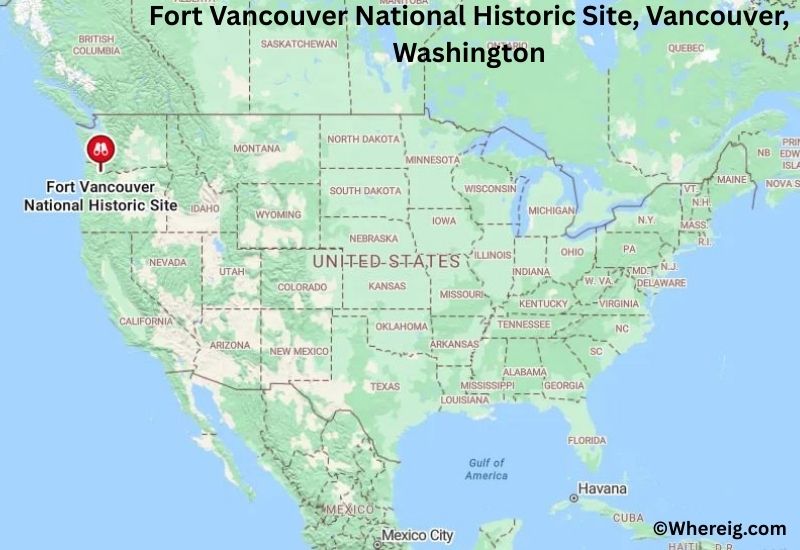
Fort Vancouver National Historic Site is located in Vancouver, Washington, USA. It lies between the Columbia River and the city of Portland, Oregon, and is situated in a river valley area. It is famous for being a historic fur trading post and an important center for the Hudson’s Bay Company.
Fort Vancouver National Historic Site Location Map, Vancouver, Washington
Washington Maps and Info
Top Attractions Inside Fort Vancouver National Historic Site
- Reconstructed Fort Buildings – Historic Hudson’s Bay Company fort structures showcasing 19th-century frontier life.
- Visitor Center & Museum – Exhibits on fur trading, regional history, and Native American culture.
- Officer’s Quarters & Barracks – Restored living spaces illustrating the daily life of fort residents.
- Blacksmith & Workshop Areas – Demonstrations of historic trades and crafts essential to the fort.
- Heritage Gardens – Recreated gardens showing plants and crops grown during the fort’s operation.
- Guided Tours & Living History Programs – Educational tours with reenactments and interpretive activities.
- Walking Trails & Scenic Overlooks – Paths around the fort offering views of the Columbia River and natural landscapes.
Fort Vancouver National Historic Site Facts
| Official Name | Fort Vancouver National Historic Site |
| Location | Vancouver, Washington, USA (on the north bank of the Columbia River; includes related unit at Oregon City, Oregon) |
| Latitude & Longitude | ≈ 45.6386° N, 122.6615° W |
| Total Area | ≈ 207 acres (Historic Site area) :contentReference[oaicite:1]{index=1} |
| Established / Built | Founded as fur‑trading post in winter 1824–1825 by the Hudson's Bay Company — officially dedicated March 9, 1825 :contentReference[oaicite:3]{index=3} |
| Relocation | Relocated in 1829 to lower plain closer to Columbia River (current reconstructed fort site) :contentReference[oaicite:4]{index=4} |
| Original Purpose / Concept | Headquarters of Hudson's Bay Company’s interior fur trade for the Pacific Northwest — controlled trade & supply from Rocky Mountains to Pacific, from Russian Alaska to Mexican California :contentReference[oaicite:5]{index=5} |
| Historic Roles & Significance | Major fur‑trade hub, early cultural & commercial center in Pacific Northwest; supplied incoming American settlers on Oregon Trail; later served as U.S. Army post (as part of Vancouver Barracks) after Oregon boundary settlement :contentReference[oaicite:7]{index=7} |
| Transition to U.S. Control | After the 1846 Oregon Treaty the region came under U.S. jurisdiction; HBC operations wound down and fort was abandoned in 1846, though U.S. Army took over site starting 1849 :contentReference[oaicite:8]{index=8} |
| Destruction & Reconstruction | Original fort burned in 1866; reconstruction of fort buildings began mid‑20th century based on archaeological remains — today the stockade and several buildings have been reconstructed for visitors :contentReference[oaicite:9]{index=9} |
| Managed By | National Park Service (part of Fort Vancouver NHS) :contentReference[oaicite:11]{index=11} |
| Region / Strategic Position | Lower Columbia River — gateway between continental interior & Pacific, key for trade, transportation & settlement in Pacific Northwest :contentReference[oaicite:12]{index=12} |
| Current Components / Units | Reconstructed Fur‑Trade Fort, historical Vancouver Barracks area, Pearson Air Museum (aviation history), and (separately) the John McLoughlin House unit in Oregon City, Oregon :contentReference[oaicite:15]{index=15} |
| Visitor Experience & Facilities | Reconstructed fort & palisade wall, historic‑building exhibits (trade, blacksmith, trade store, chief‑factor house), living‑history demonstrations, museum exhibits, aviation museum, walking trails, educational programs, access to riverfront & park lands :contentReference[oaicite:16]{index=16} |
| Significant Firsts / Contributions | Hosted first hospital, school, library, grist mill, saw‑mill, dairy, ship‑building facility, orchard in the region — early centre of settlement & infrastructure in Pacific Northwest :contentReference[oaicite:17]{index=17} |
| Historic & Cultural Importance | Served as centre for cross-cultural trade & settlement; vital link for Indigenous trade, early European & colonial commerce, support to American settlers; played a role in transition of Pacific Northwest from British to American control :contentReference[oaicite:18]{index=18} |
| National Historic Site Designation | Declared a National Monument June 19, 1948; redesignated a National Historic Site June 30, 1961 :contentReference[oaicite:19]{index=19} |
| Park / Reserve Context | Part of the broader Vancouver National Historic Reserve established in 1996, covering historic fort area, adjacent barracks, riverfront, and associated lands :contentReference[oaicite:21]{index=21} |
| Official Website / Info Source | https://www.nps.gov/fova/ |
Distances from Fort Vancouver National Historic Site to Nearby Landmarks
- Vancouver Waterfront Park – 1 km (0.6 mi)
- Esther Short Park – 1 km (0.6 mi)
- Vancouver Land Bridge – 1.5 km (0.9 mi)
- Columbia River – 1 km (0.6 mi)
- Officer’s Row Historic Homes – 0.3 km (0.2 mi)
- Pearson Field (historic airfield) – 1.8 km (1.1 mi)
- Hudson’s Bay Company Warehouse – 0.2 km (0.1 mi)
- Water Resources Education Center – 0.5 km (0.3 mi)
- Vancouver Barracks – 0.3 km (0.2 mi)
- Fort Vancouver Regional Library – 2 km (1.2 mi)
- Clark County Historical Museum – 1 km (0.6 mi)
- Columbia River Waterfront Trail – 1.5 km (0.9 mi)
- Clark College – 4 km (2.5 mi)
- Vancouver Mall – 6 km (3.7 mi)
- Reed Island / Columbia River access – 2 km (1.2 mi)
Top Places to Visit in Washington
Explore the most popular tourist places in Washington. The list below includes famous beaches, national parks, historic sites, and scenic attractions across the state, along with map locations.
Explore the complete list of places to visit in the United States, including national parks, cities, landmarks, and famous attractions.