
Mount St. Helens Observatory is located in Skamania County, Washington, USA. It lies between the Columbia River and Spirit Lake and is situated in a volcanic mountain area. It is famous for monitoring the volcanic activity of Mount St. Helens and educating visitors about the 1980 eruption.
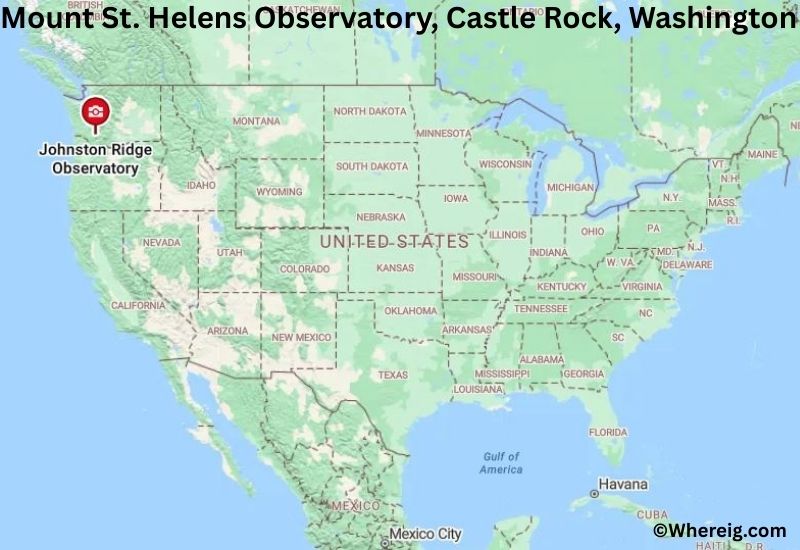
Mount St. Helens Observatory Location Map, Castle Rock, Washington
Washington Maps and Info
Top Attractions Inside Mount St. Helens Observatory
- Visitor Center Exhibits – Displays on the 1980 eruption, volcanic geology, and Mount St. Helens’ ecosystem.
- Observation Deck – Panoramic views of the volcano, crater, and surrounding blast zone.
- Interactive Learning Stations – Hands-on exhibits explaining volcanic activity and monitoring techniques.
- Guided Ranger Programs – Educational talks and hikes led by rangers detailing the eruption and recovery.
- Hiking Trails – Scenic paths around the observatory offering views of lava fields, forests, and wildlife.
- Photography & Scenic Overlooks – Ideal spots for capturing the dramatic volcanic landscape.
- Gift Shop & Educational Materials – Resources, books, and souvenirs focused on geology and natural history.
Mount St. Helens Observatory Facts
| Official Name | Mount St. Helens Volcano Observatory (USGS) |
| Location | Mount St. Helens, Skamania County, Washington, USA |
| Latitude & Longitude | 46.1912° N, 122.1944° W |
| Total Area | Observatory Facility (1–2 acres) within Gifford Pinchot National Forest (1.3 million acres) |
| Opened / Established | 1980 (following 1980 eruption; ongoing scientific monitoring) |
| Founder | U.S. Geological Survey (USGS) |
| Managed By | United States Geological Survey – Volcano Hazards Program |
| Region | Pacific Northwest – Cascade Range, Washington State |
| Address | Observer facilities located near Johnston Ridge, Mount St. Helens National Volcanic Monument, WA 98616, USA |
| Zip Code | 98616 |
| Area Code | 360 |
| Currency | United States Dollar (USD, $) |
| Time Zone | Pacific Time (PT) — UTC−8 Standard / UTC−7 Daylight Saving |
| Theme / Concept | Volcano Monitoring, Geology, Earth Science, Eruption Observation |
| Major Features | Seismic Monitoring Instruments – Observation Decks – Visitor Center Exhibits – Research Laboratories |
| Famous Attractions | Johnston Ridge Observatory – Volcano Visitor Center – Eruption Crater Viewpoints – Interpretive Trails |
| Annual Visitors | Approx. 200,000–300,000 visitors per year |
| Entry Fee Type | Paid Admission for Visitor Center & Monument Areas; Observatory Access primarily for research |
| Ticket Price Range | $0–$10 per vehicle (Mount St. Helens National Volcanic Monument Day Use Fee) |
| Visitor Options | Self-Guided Tours – Hiking Trails – Guided Ranger Programs – Educational Exhibits |
| Best Time to Visit | Summer–Fall (June–October) for best access and weather |
| Nearby Airport | Portland International Airport (PDX) – 60 miles (97 km) |
| Transportation | Car – Shuttle (seasonal) – Hiking Trails Access |
| Official Website | https://www.fs.usda.gov/recarea/giffordpinchot/recarea/?recid=31313 |
Distances from Mount St. Helens Observatory to Nearby Landmarks
- Mount St. Helens Visitor Center – 0.5 km (0.3 mi)
- Harry’s Ridge Trailhead – 2 km (1.2 mi)
- Boundary Trailhead – 5 km (3.1 mi)
- Johnston Ridge Observatory – 7 km (4.3 mi)
- Lava Canyon Trail – 8 km (5 mi)
- Windy Ridge Viewpoint – 12 km (7.5 mi)
- Mount Margaret Backcountry – 15 km (9.3 mi)
- Spirit Lake Viewpoint – 16 km (10 mi)
- Silver Lake – 23 km (14.3 mi)
- Toutle River – 20 km (12.5 mi)
- Castle Rock, WA – 48 km (30 mi)
- Vancouver, WA – 80 km (50 mi)
- Portland, OR – 92 km (57 mi)
- Gifford Pinchot National Forest – 25 km (15.5 mi)
- Mount Adams – 60 km (37 mi)
Top Places to Visit in Washington
Explore the most popular tourist places in Washington. The list below includes famous beaches, national parks, historic sites, and scenic attractions across the state, along with map locations.
Explore the complete list of places to visit in the United States, including national parks, cities, landmarks, and famous attractions.