
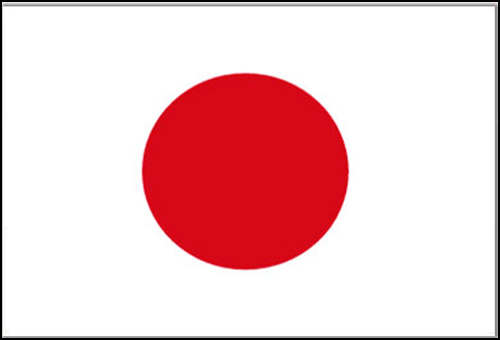
The flag of Japan, known as the Nisshōki or Hinomaru, features a red circle symbolizing the rising sun on a white background. It represents purity, sincerity, and Japan’s identity as the “Land of the Rising Sun.
The National Flag of Japan
About Japan Flag
Japan Flag: The national flag of Japan is a rectangle of white cloth with a red-and-crimson circle in the middle. The Nisshōki is the actual name of this flag, but the Hinomaru is its well-known nickname in Japan. The phrase "The Land of the Rising Sun" perfectly describes it.
The Act on National Flag and Anthem, which was enacted on August 13, 1999, designates the Nisshoki flag as the country's flag. The sun-disc flag had already established itself as Japan's de facto national flag, despite the fact that no national flag had been specified by earlier legislation. The early Meiji period's governing body, the Daij-kan, issued two proclamations in 1870, both of which included specifications for the national flag's design. Under Proclamation No. 57 of Meiji 3 and Proclamation No. 651, respectively, a sun-disc flag was approved as the national flag for merchant ships and as the flag flown by the Navy.
According to legend, the sun goddess Amaterasu, who was related to Jimmu, the first emperor of Japan, created the country in the seventh century BC. Even today, the emperor is referred to as the "Son of the Sun," and the phrase "Land of the Rising Sun" is frequently used to refer to the nation. The use of a sun flag in Japan was first documented in writing in the year 1184, although there are oral traditions that go back much further.
According to the ancient history book Shoku Nihongi, Emperor Monmu displayed a flag with a sun theme in his court for the first time in recorded Japanese history in 701. The oldest known Japan flag, which predates the 16th century, is kept in Unp-ji Temple in Ksh, Yamanashi. According to an antiquated tale, Emperor Go-Reizei donated the flag to the temple in the 11th century. The sun disc and the Rising Sun Ensign of the Imperial Japanese Navy and Army were significant emblems in the new Japanese Empire during the Meiji Restoration. The flag was portrayed as a symbol of national pride and patriotism in propaganda posters, novels, and movies.
During national holidays, festivities, and other events deemed appropriate by the government, inhabitants of Japan were obliged to fly the flag in their homes. Throughout the Second Sino-Japanese War and subsequent battles, the public became fond of a variety of devotional mementos to Japan and its Emperor that featured the Hinomaru pattern. These mementos ranged from messages scrawled on the flag to apparel and kitchenware decorated to look like the flag.
Japan Flag Facts
| Country | Japan |
| Capital | Tokyo |
| Currency | Japanese Yen (JPY) |
| Official Language | Japanese |
| ISO Country Code | JPN |
| Adopted On | 13 August 1999 (officially recognized by law) |
| Design By | Hinomaru design standardized by the Japanese government |
| National Day | 11 February (National Foundation Day) |
| National Song | Kimigayo (National Anthem of Japan) |
| Flag Ratio | 2:3 |
| Colors | White, Red |
| Design | White field with a red circular sun disc in the center |
| Center Symbol | Red sun disc (Hinomaru) |
| Meaning of Red | Represents the rising sun, sincerity, and warmth |
| Meaning of White | Symbolizes purity, honesty, and integrity |
| Cultural Influence | Based on Shinto beliefs and the idea of Japan as the “Land of the Rising Sun” |
| Unique Feature | One of the world’s simplest and oldest national flag designs |
- Albania Flag
- Antarctica Flag
- Antigua Flag
- Argentina Flag
- Bahamas Flag
- Belize Flag
- Bolivia Flag
- Burma Flag
- China Flag
- Congo Kinshasa Flag
- Costa Rica Flag
- Cyprus Flag
- Dominica Flag
- Ecuador Flag
- Egypt Flag
- El Salvador Flag
- England Flag
- Equatorial Guinea Flag
- Estonia Flag
- Ethiopia Flag
- European Union Flag
- Falkland Islands Flag
- Faroes Flag
- Fiji Flag
- Finland Flag
- France Flag
- French Guiana Flag
- French Polynesia Flag
- Gabon Flag
- Gambia Flag
- Georgia Flag
- Germany Flag
- Ghana Flag
- Gibraltar Flag
- Greece Flag
- Greenland Flag
- Grenada Flag
- Guatemala Flag
- Guernsey Flag
- Guinea Bissau Flag
- Guinea Flag
- Haiti Flag
- Honduras Flag
- Hong Kong Flag
- Hungary Flag
- Iceland Flag
- India Flag
- Indonesia Flag
- Iraq Flag
- Ireland Flag
- Isle Of Man Flag
- Isreal Flag
- Italy Flag
- Jamaica Flag
- Japan Flag
- Jersey Flag
- Jordan Flag
- Kazakhstan Flag
- Kenya Flag
- Kuwait Flag
- Kyrgyzstan Flag
- Laos Flag
- Latvia Flag
- Lebanon Flag
- Lesotho Flag
- Liberia Flag
- Libya Flag
- Liechtenstein Flag
- Lithuania Flag
- Luxembourg Flag
- Macao Flag
- Macedonia Flag
- Madagascar Flag
- Malawi Flag
- Malaysia Flag
- Maldives Flag
- Mali Flag
- Malta Flag
- Marshall Islands Flag
- Mauritania Flag
- Mauritius Flag
- Mexico Flag
- Micronesia Flag
- Moldova Flag
- Monaco Flag
- Mongolia Flag
- Montserrat Flag
- Morocco Flag
- Mozambique Flag
- Namibia Flag
- Nato Flag
- Nauru Flag
- Nepal Flag
- Netherlands Antilles Flag
- Netherlands Flag
- New Zealand Flag
- Nicaragua Flag
- Niger Flag
- Nigeria Flag
- Niue Flag
- Nordic Council Flag
- Northern Marianas Flag
- Norway Flag
- Oas Flag
- Oman Flag
- Pacific Community Flag
- Pakistan Flag
- Palau Flag
- Palestine Flag
- Panama Flag
- Papua New Guinea Flag
- Paraguay Flag
- Peru Flag
- Philippines Flag
- Poland Flag
- Portugal Flag
- Puerto Rico Flag
- Red Cross Flag
- Romania Flag
- Russian Federation Flag
- Rwanda Flag
- Saint Lucia Flag
- Samoa Flag
- San Marino Flag
- Sao Tome Principe Flag
- Scotland Flag
- Senegal Flag
- Serbia Montenegro Flag
- Seychelles Flag
- Singapore Flag
- Slovakia Flag
- Slovenia Flag
- Solomon Islands Flag
- Somalia Flag
- South Africa Flag
- South Korea Flag
- Spain Flag
- St Helena Dependencies Flag
- St Kitts Nevis Flag
- St Vincent The Grenadines Flag
- Suriname Flag
- Swaziland Flag
- Sweden Flag
- Switzerland Flag
- Syria Flag
- Taiwan Flag
- Tajikistan Flag
- Tanzania Flag
- Thailand Flag
- Timor Flag
- Togo Flag
- Tonga Flag
- Trinidad Tobago Flag
- Tunisia Flag
- Turkey Flag
- Turks Caicos Islands Flag
- Tuvalu Flag
- Uganda Flag
- Ukraine Flag
- United Arab Emirates Flag
- United Kingdom Flag
- United Nations Flag
- Uruguay Flag
- US Flag
- Uzbekistan Flag
- Vanuatu Flag
- Vatican City Flag
- Venezuela Flag
- Vietnam Flag
- Virgin Islands Flag
- Wales Flag
- Yemen Flag
- Zambia Flag