
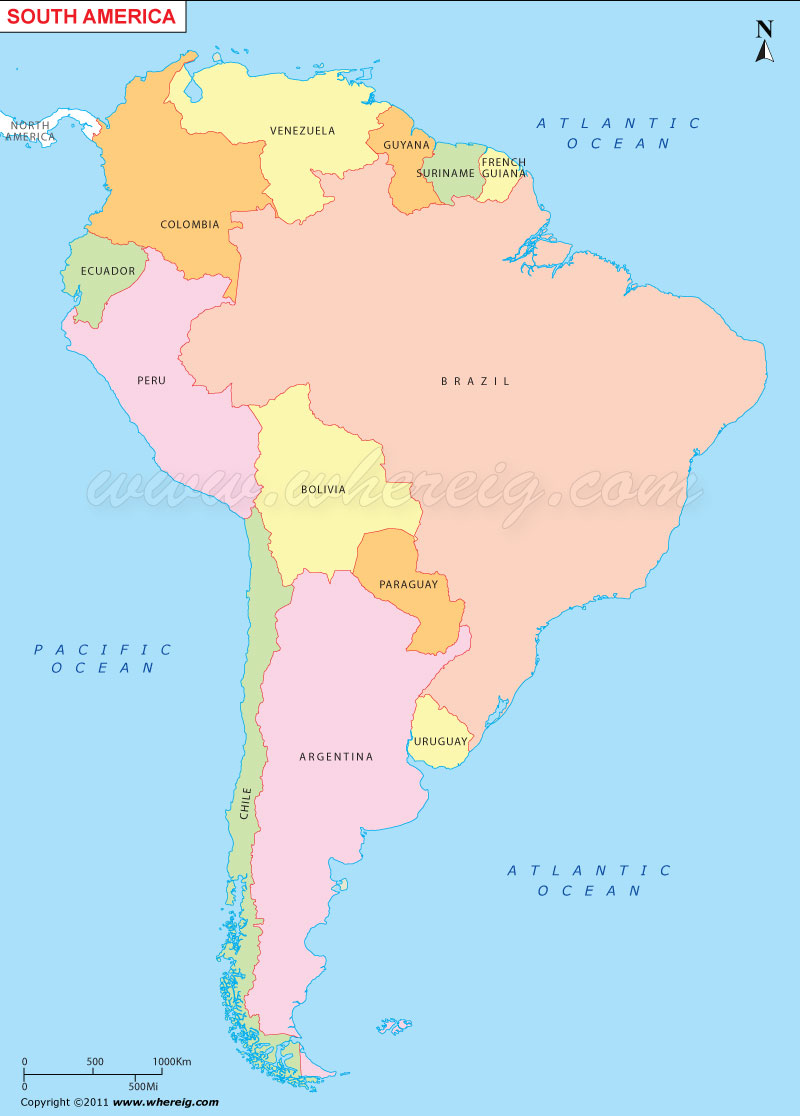
Detailed South America Map with Nations and Borders - Comprising 12 Countries, South America is a continent in the Western Hemisphere, the 4th largest continent in the world by area and the fifth-most populous. South America is bordered to the west by the Pacific Ocean and to the north and east by the Atlantic Ocean, with North America and the Caribbean Sea situated to the northwest.
Map of South American Countries
Top Viewed Links
| Africa Map | Europe Map | North America Map | Asia Map | Oceania Map |
About South America
South America is located mainly in the Southern Hemisphere, with a small portion extending into the Northern Hemisphere. It lies entirely in the Western Hemisphere and is the fourth-largest continent in the world.
The continent consists of 12 independent countries and three major dependent territories — French Guiana, the Falkland Islands, and South Georgia and the South Sandwich Islands. South America covers an area of about 6,890,000 square miles (17,840,000 square kilometres). The estimated population of South America is 439,719,009 (2024), according to the United Nations World Population Prospects 2024. Christianity is the dominant religion, although communities also practice Islam, Judaism, Buddhism, Hinduism, and other faiths. Spanish and Portuguese are the most widely spoken languages, while English, Dutch, and French are official in some regions. Immigrant languages such as German, Italian, Arabic, and Japanese are also spoken across the continent.
Also Read South American Countries and Capitals List
South America is thought to have been first inhabited by at least 15,000 years ago. The people were moving south through North America, and eventually reached South America through the Isthmus of Panama. The natural resources of the region were constantly exploited by the European conquests (Portugal and Spain) during the 1530s.
Tourism is an important industry enhancing the GDP of the continent. Historical places, architectural and natural wonders and beautiful landscapes attract millions of tourists every year from all across the globe to the continent. Machu Picchu, the Amazon Rainforest, Rio de Janeiro, Salvador, Fortaleza, Maceio, Bogota, Florianopolis, Isla Margarita, Natal, Buenos Aires, Sao Paulo, Angel Falls, Cuzco, Lake Titicaca, Patagonia, Cartagena and the Galapagos islands are the most visited places.
History
These nations then claimed the land and resources as their own and divided it into colonies. After a series of battles fought, South American countries finally won their independence at the end of 1823 from the Spanish Crown in the Spanish American wars of independence. The important leaders during the independence struggles were Simon Bolivar of Venezuela and Jose de San Martin of Argentina.
Country and Dependency in South America
| # | Country (or dependency) | Population (2025 est.) | Density (P/Km²) | Land Area (Km²) |
|---|---|---|---|---|
| 1 | Brazil | 213,562,666 | 26 | 8,358,140 |
| 2 | Colombia | 53,936,226 | 49 | 1,109,500 |
| 3 | Argentina | 47,067,441 | 17 | 2,736,690 |
| 4 | Peru | 34,922,148 | 27 | 1,280,000 |
| 5 | Venezuela | 28,633,711 | 32 | 882,050 |
| 6 | Chile | 19,945,850 | 27 | 743,532 |
| 7 | Ecuador | 18,190,484 | 73 | 248,360 |
| 8 | Bolivia | 12,388,571 | 11 | 1,083,300 |
| 9 | Paraguay | 6,861,524 | 17 | 397,300 |
| 10 | Uruguay | 3,499,451 | 20 | 175,020 |
| 11 | Guyana | 813,834 | 4 | 196,850 |
| 12 | Suriname | 623,236 | 4 | 156,000 |
| 13 | French Guiana | 312,155 | 4 | 82,200 |
| 14 | Falkland Islands | 3,791 | 0.3 | 12,170 |
Largest Cities in South America
| # | Name | Country | Population (City Proper) |
|---|---|---|---|
| 1 | São Paulo | Brazil | 11,904,961 (2025 est.) |
| 2 | Lima | Peru | 10,092,000 (2023 est.) |
| 3 | Bogotá | Colombia | 7,862,277 (2024 est.) |
| 4 | Rio de Janeiro | Brazil | 6,730,729 (2025 est.) |
| 5 | Santiago | Chile | 6,254,314 (2017 est.) |
| 6 | Caracas | Venezuela | 3,289,886 (2015 est.) |
| 7 | Buenos Aires | Argentina | 3,121,707 (2022 est.) |
| 8 | Brasília | Brazil | 2,996,899 (2025 est.) |
| 9 | Medellín | Colombia | 2,657,772 (2024 est.) |
| 10 | Guayaquil | Ecuador | 2,650,288 (2022 est.) |
| 11 | Fortaleza | Brazil | 2,578,483 (2025 est.) |
| 12 | Salvador | Brazil | 2,564,204 (2025 est.) |
| 13 | Belo Horizonte | Brazil | 2,415,872 (2025 est.) |
| 14 | Manaus | Brazil | 2,303,732 (2025 est.) |
Source: City population figures based on the most recent official estimates, census data, or short-term projections available
South America Facts
| Number of Countries | 12 Sovereign Countries |
| Dependencies / Territories | 3 (French Guiana, Falkland Islands, South Georgia & South Sandwich Islands) |
| Area | 17,840,000 km² (6,890,000 sq mi) - 4th Largest Continent |
| Population (2024) | 439,719,009 (United Nations World Population Prospects 2024) |
| Population Density | Approximately 25 people per km² |
| Largest Country (Area & Population) | Brazil |
| Smallest Country | Suriname |
| Highest Peak | Aconcagua - 6,961 metres (22,838 feet), Argentina |
| Longest Mountain Range | Andes Mountains (Approx. 7,000 km) |
| Lowest Point | Laguna del Carbón, Argentina - 105 metres (344 feet) below sea level |
| Longest River | Amazon River (Approx. 6,400 km) |
| Largest Rainforest | Amazon Rainforest |
| Largest Lake | Lake Titicaca (by volume and size in the region) |
| Largest City | São Paulo, Brazil |
| Oldest Civilization | Norte Chico Civilization (c. 3000 BCE, Peru) |
| Colonial Influence | Mainly Spanish and Portuguese |
| Principal Religion | Christianity (majority Roman Catholic) |
| Major Languages | Spanish, Portuguese, English, Dutch, French, Quechua, Guaraní, Aymara |
| Major Economic Sectors | Agriculture, Mining, Oil & Gas, Manufacturing, Services |
| Major Exports | Soybeans, Coffee, Copper, Iron Ore, Petroleum |
| Time Zones | UTC−02:00 to UTC−05:00 |
| Demonym | South American |