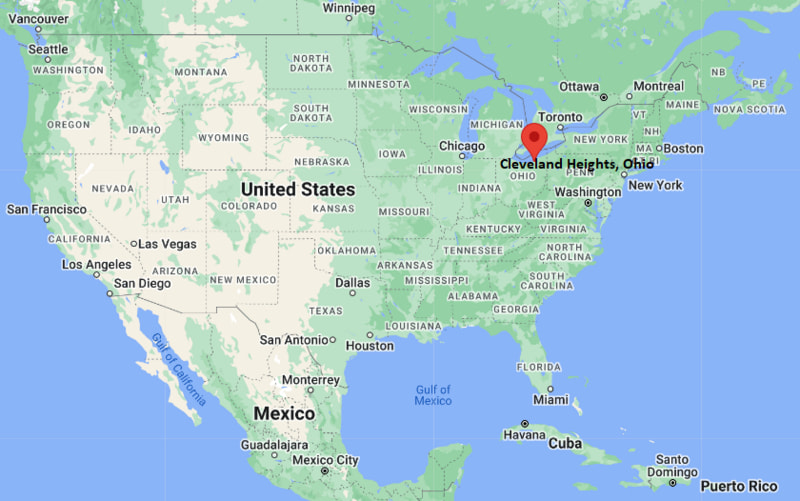
Where is Cleveland Heights Located? - Cleveland Heights is a city located in the Cuyahoga County of Ohio, United States. Cleveland Heights lies between 40.700936 Degrees North latitudes and 73.712909 Degrees West longitudes.
Location Map of Cleveland Heights, Ohio
Cleveland Heights Map, Ohio, USA
Where is Cleveland Heights?: The Google Map showing the location of Cleveland Heights in the U.S. state of Ohio.
Where is Cleveland Heights Located?
Cleveland Heights is a city located in the Cuyahoga County of Ohio, United States. Cleveland Heights lies between 40.700936 Degrees North latitudes and 73.712909 Degrees West longitudes. According to 2020 U.S.census, the population of Cleveland Heights city is 45312 people and the city has a total area of 8.1 sq mi. The city has numerous parks and recreational facilities.
Cleveland Heights, Ohio Climate and Weather Overview
Month
Avg High (°F)
Avg Low (°F)
Avg Rainfall (in)
January
34
21
2.6
April
58
40
3.5
July
82
66
3.9
October
63
47
3.2
Annual
59
44
39.8
Climate Attribute
Details
Climate Classification (Köppen)
Hot-Summer Humid Continental (Dfa)
Annual Rainfall
About 39.8 in
Annual Sunshine Days
Approximately 166 days
Hurricane/Tornado Risk
Very low hurricane risk; low tornado risk
Snowfall
About 67 in annually
Driving Distances from Cleveland Heights, Ohio
City
State
Distance (mi)
Approx. Drive Time
Cleveland
Ohio
7
15 min
Euclid
Ohio
8
15 min
Mentor
Ohio
20
30 min
Akron
Ohio
38
45 min
Elyria
Ohio
36
45 min
Medina
Ohio
42
50 min
Youngstown
Ohio
67
1 hr 10 min
Sandusky
Ohio
70
1 hr 20 min
Toledo
Ohio
117
2 hr
Columbus
Ohio
143
2 hr 20 min
Transportation and Connectivity in Cleveland Heights, Ohio
Feature
Details
Airport Name
Cleveland Hopkins International Airport
IATA Code
CLE
Port
Port of Cleveland
Major Highways
US 20, Interstate 90 (nearby), Interstate 271, State Route 87, State Route 8
Train/Amtrak Service
Nearest Amtrak station in downtown Cleveland
Local Bus/Transit Service
Greater Cleveland Regional Transit Authority (RTA) bus and nearby rail service
U.S. Route 20 - Connects Cleveland Heights with downtown Cleveland and eastern suburbs.
Interstate 90 - Major east-west interstate providing regional access across northern Ohio.
Interstate 271 - Bypass route connecting eastern suburbs with Interstate 90 and Interstate 480.
State Route 87 (Carnegie Avenue/Cedar Road) - Important corridor linking the city with University Circle and downtown Cleveland.
Greater Cleveland RTA - Provides extensive bus service with convenient connections to the Red, Blue, and Green rail lines.
Key Landmarks and Places to Visit in Cleveland Heights, Ohio
Landmark Name
Type
Cain Park
City Park
Cleveland Heights Community Center
Community Center
Coventry Village
Entertainment District
Cumberland Park
City Park
Severance Music Center
Concert Hall
Cleveland Museum of Art
Museum
Cleveland Botanical Garden
Botanical Garden
Lake View Cemetery
Historic Cemetery
University Circle
Cultural District
Museum of Contemporary Art Cleveland
Museum
Colleges and Universities in Cleveland Heights, Ohio
Institution Name
Type
Level
Notable For
John Carroll University
Private
University
Jesuit liberal arts education
Case Western Reserve University
Private
University
Research university
Cleveland Institute of Art
Private
University
Art and design programs
Cleveland Institute of Music
Private
University
Classical music education
Cuyahoga Community College - Eastern Campus
Public
Community College
Career and transfer programs
Waterbodies in Cleveland Heights, Ohio
Lake Erie, Doan Brook, Dugway Brook, Euclid Creek, Mill Creek, Rockefeller Lagoon, Wade Lagoon, Shaker Lakes, Green Lake, Horseshoe Lake
Golf Courses in Cleveland Heights, Ohio
Mayfield Sand Ridge Club, Highland Park Golf Course, Little Met Golf Course, StoneWater Golf Club, Manakiki Golf Course, Sleepy Hollow Golf Course, Shawnee Hills Golf Course, Briardale Greens Golf Course
Cleveland Heights, Ohio - Key Historical Facts
Cleveland Heights began developing in the late 19th century as a residential streetcar suburb east of downtown Cleveland.
The city officially incorporated as a village in 1903 and became a city in 1921 as its population grew rapidly.
Its tree-lined neighborhoods and early 20th-century architecture attracted professionals working in nearby Cleveland.
The city's proximity to University Circle helped establish Cleveland Heights as a center for education, healthcare, and the arts.
Coventry Village became a well-known cultural district during the 1960s and remains a popular destination for shopping, dining, and entertainment.
Today, Cleveland Heights is recognized for its historic neighborhoods, diverse community, and easy access to many of Greater Cleveland's cultural attractions.