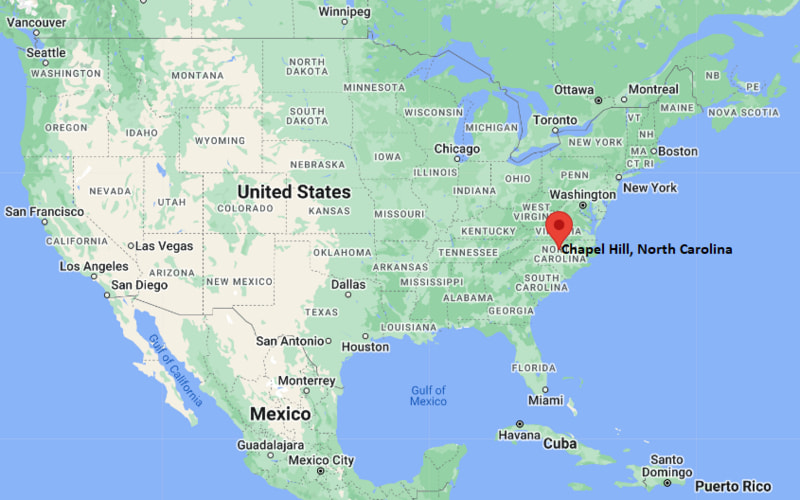
Where is Chapel Hill Located? - Chapel Hill is a city located in the Orange, Durham County of North Carolina, United States. Chapel Hill lies between 32.7726565 Degrees North latitudes and 103.126161 Degrees West longitudes.
Location Map of Chapel Hill, North Carolina
Chapel Hill Map, North Carolina, USA
Where is Chapel Hill?: The Google Map showing the location of Chapel Hill in the U.S. state of North Carolina.
Where is Chapel Hill Located?
Chapel Hill is a city located in the Orange, Durham County of North Carolina, United States. Chapel Hill lies between 32.7726565 Degrees North latitudes and 103.126161 Degrees West longitudes. According to 2020 U.S.census, the population of Chapel Hill city is 61960 people and the city has a total area of 21.53 sq mi. The city has numerous parks and recreational facilities.
Orange County (primarily), Durham County, Chatham County
State
North Carolina
State Capital
Raleigh
US Region
South
Latitude
35.9132° N
Longitude
79.0558° W
Elevation
512 ft (156 m)
Land Area
21.31 sq mi
Water Area
0.23 sq mi
Total Area
21.54 sq mi
Population (2020 Census)
61,960
Population Density
2,907 per sq mi
ZIP Codes
27514, 27516, 27517, 27599
Area Code
919, 984
Time Zone Standard
Eastern Standard Time (EST, UTC-5)
Time Zone Daylight
Eastern Daylight Time (EDT, UTC-4)
Currency
US Dollar (USD)
FIPS Code
37-11800
Congressional District
4th Congressional District
Nearby Cities and Towns to Chapel Hill, North Carolina
Carrboro, North Carolina - 2 mi
Hillsborough, North Carolina - 12 mi
Durham, North Carolina - 13 mi
Pittsboro, North Carolina - 17 mi
Morrisville, North Carolina - 20 mi
Cary, North Carolina - 23 mi
Apex, North Carolina - 24 mi
Raleigh, North Carolina - 30 mi
Burlington, North Carolina - 32 mi
Sanford, North Carolina - 37 mi
Chapel Hill, North Carolina Climate and Weather Overview
Month
Avg High (°F)
Avg Low (°F)
Avg Rainfall (in)
January
50
30
3.5
April
72
48
3.4
July
89
69
4.8
October
73
49
3.2
Annual
71
49
46.0
Climate Attribute
Details
Climate Classification (Köppen)
Humid Subtropical (Cfa)
Annual Rainfall
About 46.0 in
Annual Sunshine Days
About 216 days
Hurricane/Tornado Risk
Low hurricane risk and low tornado risk
Snowfall
About 6 in annually
Driving Distances from Chapel Hill, North Carolina
City
State
Distance (mi)
Approx. Drive Time
Carrboro
North Carolina
2
5 min
Hillsborough
North Carolina
12
20 min
Durham
North Carolina
13
20 min
Pittsboro
North Carolina
17
25 min
Morrisville
North Carolina
20
25 min
Cary
North Carolina
23
30 min
Apex
North Carolina
24
35 min
Raleigh
North Carolina
30
40 min
Burlington
North Carolina
32
40 min
Sanford
North Carolina
37
45 min
Transportation and Connectivity in Chapel Hill, North Carolina
Transportation
Details
Airport Name
Raleigh-Durham International Airport
IATA Code
RDU
Port
No commercial port
Major Highways
U.S. Highway 15-501, U.S. Highway 54, Interstate 40, NC Highway 86
Train/Amtrak Service
Nearest Amtrak stations in Durham and Cary
Local Bus/Transit Service
Chapel Hill Transit, GoTriangle
Interstate 40 and U.S. Highways 15-501 and 54 provide convenient access to Durham, Raleigh, Greensboro, and the rest of the Research Triangle.
Raleigh-Durham International Airport is approximately 18 miles east and offers extensive domestic and international connections.
Chapel Hill Transit provides fare-free local bus service, while GoTriangle connects the town with Raleigh, Durham, Cary, and Research Triangle Park.
Amtrak passenger rail service is available from nearby Durham and Cary stations.
Chapel Hill is internationally recognized as the home of the University of North Carolina at Chapel Hill and is a major center for education, healthcare, biotechnology, and research.
Key Landmarks and Places to Visit in Chapel Hill, North Carolina
Landmark Name
Type
University of North Carolina at Chapel Hill
Historic University Campus
Morehead Planetarium and Science Center
Planetarium
North Carolina Botanical Garden
Botanical Garden
Coker Arboretum
Arboretum
Ackland Art Museum
Art Museum
Dean E. Smith Center
Sports Arena
Kenan Memorial Stadium
Football Stadium
Carolina Basketball Museum
Sports Museum
Battle Park
Nature Preserve
Franklin Street
Historic Shopping and Dining District
Colleges and Universities in and near Chapel Hill, North Carolina
Institution Name
Type
Level
Notable For
University of North Carolina at Chapel Hill
Public
University
Medicine, public health, business, law, and world-class research
Duke University
Private
University
Medicine, engineering, business, and research
North Carolina Central University
Public
University
Law, education, business, and health sciences
Durham Technical Community College
Public
Community College
Career training, healthcare, and university transfer programs
Wake Technical Community College
Public
Community College
Technical education, information technology, and workforce development
Waterbodies in Chapel Hill, North Carolina
Morgan Creek, Bolin Creek, University Lake, Jordan Lake, New Hope Creek, Cane Creek Reservoir, Haw River, Eno River
Golf Courses in and near Chapel Hill, North Carolina
Finley Golf Club, The Preserve at Jordan Lake Golf Club, Governors Club Golf Course, Chapel Hill Country Club, Duke University Golf Club, Occoneechee Golf Club, Hillandale Golf Course, Falls Village Golf Club
Chapel Hill, North Carolina - Key Historical Facts
Chapel Hill was established in 1793 when North Carolina selected the site for the state's first public university, the University of North Carolina.
The town grew around the university, which welcomed its first students in 1795 and became one of the oldest public universities in the United States.
Throughout the nineteenth and twentieth centuries, Chapel Hill developed into a nationally recognized center for education, culture, and medical research.
The town became a key part of North Carolina's Research Triangle, contributing to advances in healthcare, biotechnology, and scientific innovation.
Franklin Street evolved into the heart of the community, known for its restaurants, shops, festivals, and university traditions.
Today, Chapel Hill is recognized for academic excellence, NCAA athletics, healthcare, cultural attractions, and its high quality of life within the Research Triangle region.