
The United States of America is the largest economy in the world, with a GDP of about $20.89 trillion. It is the third-largest country by land area and the third-most populous country in the world. The USA consists of 50 states and one federal district. The capital city of the country is Washington, D.C. Major cities in the United States include New York City, Los Angeles, Chicago, Houston, Phoenix, Philadelphia, San Antonio, San Diego, Dallas, San Jose, San Francisco, Seattle, Boston, Miami, and Las Vegas.
United States of America Map
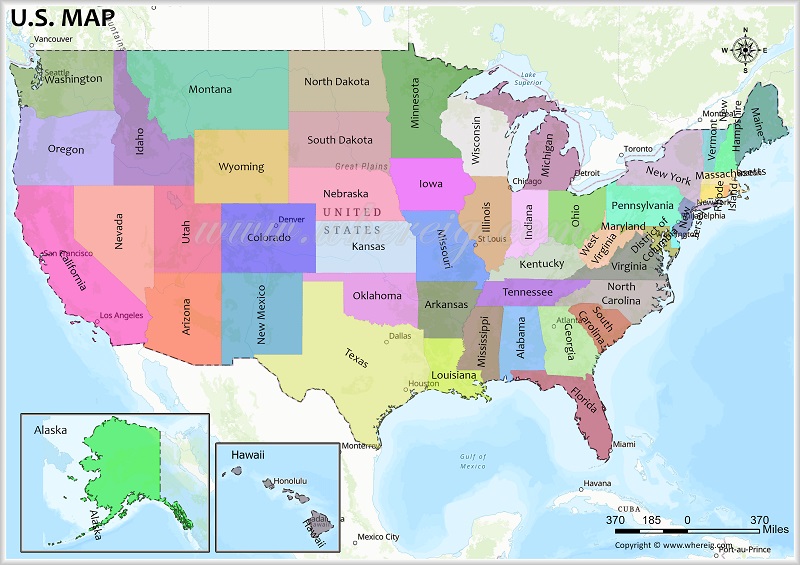 About Map: US Map showing United States 50 states & International boundary.
| USA Map 1000 X 706 Size | USA Map with High Resolution |
PDF Free US Map
About USA Map
The United States of America map shows that the United States is located in the central part of North America Continent. US map also shows that it shares its international boundaries with Canada in the north and Mexico in the south. Besides, Pacific Ocean lies in the west, Atlantic Ocean lies in the east and Mexico Gulf in the south.
The Map of US shows that 48 states of the US are the part of mainland and rest two i.e. Alaska lies in the north-west of Canada which is separated by Bering Strait from Russian Federation and second one is Hawaii – it is a group of islands located in the mid-Pacific Ocean.
The capital city of the US is Washington DC, however, the largest city is New York. Other highly advanced cities are Los Angeles, Chicago, Houston, Philadelphia, Phoenix, San Diego etc. The government type of the US is a constitutional republic and representative democracy featured with two party systems. Furthermore, the US government is regulated by a system of checks and balances administered by the US Constitution. US constitution is the supreme legal document of the country. Above all, the US is the world's oldest surviving federation.
Geography of United States of America
The United States is situated in North America, between Canada and Mexico. The United States borders the Pacific Ocean along its western coast, and the Atlantic Ocean along its eastern coast. Southeastern United States sits along the Gulf of Mexico, and Alaska is located next to the Arctic Ocean and Bering Sea.
From its many miles of coastlines with their sandy beaches, the tropical Hawaiian Islands, to its mountain ranges like the Rockies and the Appalachians, the United States has a wide variety of terrains. Major rivers in the United States include the Mississippi River that traverses the country, and combined with the Missouri River, form a the fourth longest river system in the world.
Map of 50 U.S. States
Counties in the United States by State
Explore Location Map of 3000 Cities in USA by State
US History
Native Americans probably migrated to the region from Asia up to 40,000 years ago. These indigenous people of the Americas lived in tribes, and were typically nomadic throughout most of their history.European explorers arrived in the late 1400s, most famously Christopher Columbus, who reached the Caribbean islands in 1492. Juan Ponce de Leon followed shortly after that, arriving in what is now Florida,as the first known European to reach the main continent. The Spanish began to establish colonies in Florida and throughout the Southwest and Mexico, followed by the French, and finally the English. The Virginia Colony in Jamestown, settled in 1607, was the first permanent English colony in the New World. Once the Massachusetts Bay Colony was chartered in 1628, many English settlers flocked to the new world.
Settlers from the Netherlands set up the New Amsterdam colony in what would later become New York, but soon gave up their territory to England. France established colonies in what is now Canada and the Louisiana Territory, which makes up a large portion of modern-day United States. Thirteen British colonies were established along the Atlantic Coast by the early eighteenth century. Throughout this, the indigenous people were exposed to the diseases of Europe, which they had never built up immunities to, and were pushed out of their lands progressively farther westward over time.
The French and Indian War, part of the Seven Years' War that took place from 1756 to 1763, was a territorial battle between the British and French colonies in North America. The war resulted in Spain ceding the Florida territory to Britain, and France ceding its territory in Canada to Britain and the Louisiana region to Spain.
The British Crown, in an effort to regain some of the money lost fighting the war, began collecting taxes from the colonists. Since the colonists did not have representation in British Parliament, they felt the taxation was unjust. These factors led to the American Revolutionary War, which broke out in 1775 and ended in 1783. The war was fought in many battles throughout the thirteen colonies, and resulted in the Declaration of Independence, which was signed on July 4, 1776. The system of government was based on the Articles of Confederation, followed by the Bill of Rights.
The Louisiana Purchase of 1803 nearly doubled the size of the United States, and was followed by battles with Spanish colonists to claim Florida for the United States in 1819. Over the rest of the century, the United States continued to expand across the continent, with the annexation of Texas, the Oregon Territory, California, and the Southwest.
Slaves had been brought into the United States since colonial times, but slavery did not spread to each of these new territories. The tensions between slave states and free states built up, leading to the Civil War from 1861 to 1865, in which the southern slave states ceded from the Union, creating the Confederacy. The Confederacy lost the Civil War, and rejoined the Union, and the slaves were freed, though still segregated in the South for years to follow.
The United States remained neutral at the start of World War I in 1914, but entered the war on the side of the Allies in 1917. During World War II, after an attack on Pearl Harbor, the United States joined the Allies once again.
US Politics
The government system of the United States is a federal republic made up of states with a degree of autonomy united under a centralized national government. At the federal level, the government is divided into three branches: the Legislative, Executive, and Judicial branches.
The Legislative branch consists of the bicameral Congress, which includes the Senate and the House of Representatives. Each state is represented by two senators in the Senate, while representation in the House of Representatives is based on the population of each state.
The United States is further divided into fifty states and one federal district, Washington, D.C. (District of Columbia). Each state is governed by an elected governor and is further divided into counties and cities. States have a degree of autonomy and can create laws on matters not specifically addressed by the U.S. Constitution. They also maintain their own court systems and state governments.
USA Travel and Tourism
The United States is a diverse and multicultural country with countless travel destinations. Major cities such as New York City, Los Angeles, San Francisco, and Chicago attract millions of visitors every year with their cultural landmarks, museums, and entertainment districts.
Natural attractions also draw travelers from around the world. The Grand Canyon and many U.S. National Parks are popular destinations for family vacations and outdoor activities. World-famous theme parks such as Disneyland in California and Walt Disney World in Florida are among the most visited tourist attractions in the country.
Education System in the US
The education system in the United States is administered at the federal, state, and local levels, primarily through school districts. Public education is free and available to all students. School attendance is generally compulsory from about age five until between fourteen and eighteen, depending on state laws.
Education typically begins with kindergarten at around age five, although preschool programs may be available earlier. After kindergarten, students progress through grades one to twelve. Elementary school usually covers first through fifth or sixth grade, middle school or junior high covers sixth or seventh through eighth grade, and high school includes ninth through twelfth grades. Students typically graduate from high school at ages seventeen or eighteen.
After high school, students may continue their education at colleges or universities to earn associate’s or bachelor’s degrees. Higher education institutions may be public or private and usually charge tuition. Scholarships, grants, and financial aid programs are often available to help students cover costs.
The United States also has an extensive community college system that offers two-year associate’s degrees. Many students begin their studies at community colleges and later transfer to four-year universities to complete bachelor’s degrees.
After earning a bachelor’s degree, students may pursue graduate or professional education, leading to master’s degrees, doctoral degrees, or other professional qualifications.
US Economy
The United States has the largest national economy in the world. Its economy is highly developed and diversified, supported by abundant natural resources, advanced technology, and strong infrastructure.
The country has significant natural resources including petroleum, natural gas, coal, and iron ore. Agriculture is also highly productive due to vast fertile land and modern farming techniques. Major industries include technology, manufacturing, finance, healthcare, and aerospace.
Because of its large geographic area, the climate of the United States varies widely. It ranges from humid continental climates in the north to temperate and Mediterranean climates in parts of the west and south.
US Fatcs
Facts About the United States
| Official Name | United States of America |
| Continent | North America |
| Capital | Washington, D.C. |
| Largest City | New York City |
| Total Area | 3,796,742 sq mi (9,833,520 sq km) |
| Population (2020 Census) | 331,449,281 |
| Population Rank | 3rd in the world |
| Number of States | 50 |
| Federal District | Washington, D.C. |
| Form of Government | Federal constitutional republic |
| Independence Day | July 4, 1776 |
| President | Donald Trump |
| Vice President | JD Vance |
| Speaker of the House | Mike Johnson |
| Currency | United States Dollar (USD) |
| GDP (Nominal) | Approx. $27 trillion (largest economy in the world) |
| Official Language | No official federal language; English is the most widely spoken |
| Major Religions | Christianity, Judaism, Islam, Buddhism, Hinduism and other faiths |
| Time Zones | UTC −4 to −12, +10, +11 (including territories) |
| International Calling Code | +1 |
| Largest State (Area) | Alaska |
| Smallest State | Rhode Island |
| Highest Point | Denali – 20,310 ft (6,190 m) |
| Longest River | Missouri River |
| Largest Lake | Lake Superior |
| National Animal | Bald Eagle |
| National Flower | Rose |
| Administrative Divisions | 50 states, the District of Columbia, and several territories including Puerto Rico, Guam, American Samoa, the U.S. Virgin Islands, and the Northern Mariana Islands |
| US Regions | Northeast, Midwest, South, and West |