
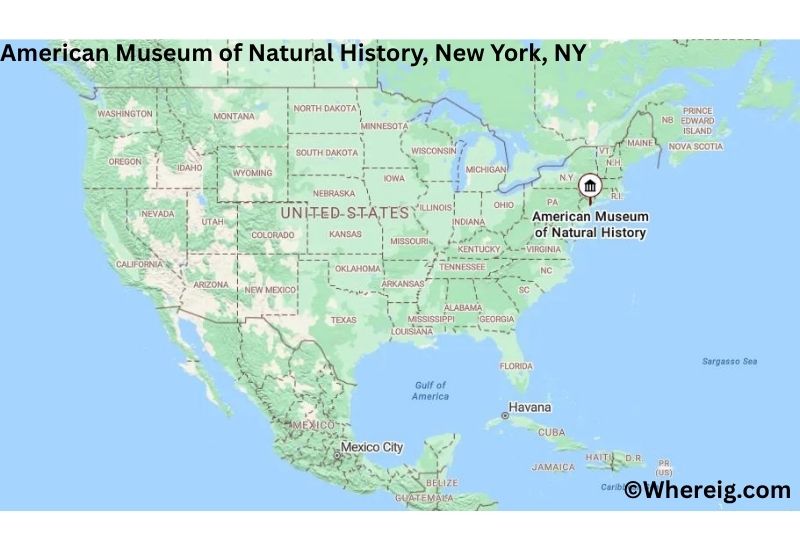
The American Museum of Natural History is located in New York City, New York, USA. It lies between Central Park West and Columbus Avenue and is situated on the Upper West Side of Manhattan. The museum is famous for its dinosaur fossils, animal exhibits, and science displays.
American Museum of Natural History Location Map, New York, NY
New York Maps and Info
| New York Map | Counties in New York | Cities in New York |
| New York Zipcodes | Airports in New York | US Zip code Map |
| New York Area Codes | New York River Map | - |
Top Attractions Inside American Museum of Natural History
- Hall of Saurischian Dinosaurs – Home to the museum’s famous T. rex and other giant dinosaur skeletons.
- Hall of Biodiversity – Explores the variety of life on Earth with immersive dioramas and exhibits.
- Rose Center for Earth and Space – Features the Hayden Planetarium and exhibits on the universe and planets.
- Hall of Ocean Life – Showcases marine ecosystems, including the iconic life-sized blue whale model.
- Hall of Human Origins – Traces the evolution of humans with fossils, reconstructions, and interactive displays.
- Hall of North American Mammals – Displays realistic dioramas of mammals in their natural habitats.
- Fossil Halls – Features an extensive collection of fossils from prehistoric animals around the world.
- Butterfly Conservatory (seasonal) – Live butterflies flying in a tropical garden environment, open seasonally.
American Museum of Natural History Facts
| Official Name | American Museum of Natural History |
| Location | 200 Central Park West, New York, NY 10024, USA |
| Latitude & Longitude (approx.) | 40.7813° N, 73.9735° W |
| Total Area / Building Complex | 21 interconnected buildings housing 45 permanent exhibition halls + planetarium & library (complex occupies a substantial part of the block along Central Park West):contentReference[oaicite:1]{index=1} |
| Established / Founded | Incorporated April 6, 1869:contentReference[oaicite:2]{index=2} |
| First Opening to Public (initial exhibits) | May 22, 1871 (at original Central Park Arsenal location):contentReference[oaicite:3]{index=3} |
| Founder / Founding Group | Founded on the initiative of naturalist Albert S. Bickmore and other civic leaders / philanthropists aiming to create a major natural-history museum in New York City:contentReference[oaicite:5]{index=5} |
| Managed By / Type | Private non-profit organization (501(c)(3)) / Natural history museum & research institution:contentReference[oaicite:6]{index=6} |
| Region | Upper West Side, Manhattan, New York City, New York, USA |
| Address | Central Park West & West 79th Street, New York, NY 10024, USA:contentReference[oaicite:7]{index=7} |
| Currency | United States Dollar (USD, $) |
| Time Zone | Eastern Time (ET) – UTC−5 Standard / UTC−4 Daylight Saving |
| Theme / Concept | Global natural history — Earth’s biodiversity, geology, paleontology, anthropology, human cultures—and Universe (via planetarium & space/astronomy exhibits):contentReference[oaicite:8]{index=8} |
| Main Sections / Departments | 45 Exhibition Halls + Planetarium (Hayden Planetarium / Rose Center for Earth & Space) + Research Library + Collections & Conservation Wings:contentReference[oaicite:9]{index=9} |
| Famous Features / Highlights | Huge natural-history collections (animals, fossils, minerals, meteorites, human cultures), dinosaur & fossil exhibits, biodiversity halls, planetarium & space/earth science exhibits, dioramas, human-culture/anthropology displays, research collections:contentReference[oaicite:10]{index=10} |
| Collection Size (specimens / artifacts) | 32–34 million specimens & artifacts (plants, animals, fossils, minerals, meteorites, human cultural and anthropological objects, etc.):contentReference[oaicite:11]{index=11} |
| Scientific / Research Staff | 200 full-time scientists across multiple research divisions:contentReference[oaicite:12]{index=12} |
| Annual Visitors | 5 million (in recent years):contentReference[oaicite:13]{index=13} |
| Entry Fee Type | Paid Admission (suggested donation; general admission + optional contributions):contentReference[oaicite:14]{index=14} |
| Suggested Admission (General Admission) | Suggested donation US$22 for adults (but pay-what-you-wish system applies):contentReference[oaicite:15]{index=15} |
| Ticket / Access Options | General Admission (suggested) • Special Exhibitions / Planetarium / Space Shows (may have extra fee):contentReference[oaicite:16]{index=16} |
| Best Time to Visit (General Advice) | Weekdays / off-peak hours for fewer crowds; mornings soon after opening often less crowded; check for special exhibitions and planetarium show times:contentReference[oaicite:17]{index=17} |
| Nearby Public Transit / Access | Accessible via NYC Subway: B, C trains to 81st Street–Museum of Natural History station; also served by buses on Central Park West / 79th Street:contentReference[oaicite:18]{index=18} |
| Official Website | https://www.amnh.org |
Distances from American Museum of Natural History to Nearby Landmarks
- Central Park – 0.8 km (0.5 mi)
- Lincoln Center – 1.3 km (0.8 mi)
- Metropolitan Museum of Art – 2.3 km (1.4 mi)
- The Plaza Hotel – 2.5 km (1.6 mi)
- Columbus Circle – 0.9 km (0.6 mi)
- Museum of Modern Art (MoMA) – 4.3 km (2.7 mi)
- Times Square – 4.5 km (2.8 mi)
- Rockefeller Center – 4.0 km (2.5 mi)
- Broadway Theater District – 4.7 km (2.9 mi)
- Grand Central Terminal – 5.7 km (3.5 mi)
- New York Public Library (5th Ave) – 5.8 km (3.6 mi)
- Empire State Building – 6.9 km (4.3 mi)
- Chrysler Building – 6.2 km (3.9 mi)
- Madison Square Garden – 6.6 km (4.1 mi)
- Hudson Yards (The Vessel) – 3.8 km (2.4 mi)
- SoHo – 8.7 km (5.4 mi)
- One World Trade Center – 10.9 km (6.8 mi)
- Statue of Liberty Ferry (Battery Park) – 12.7 km (7.9 mi)
- Brooklyn Bridge – 11.4 km (7.1 mi)
- Fifth Avenue Shopping District – 4.0 km (2.5 mi)
Top Places to Visit in New York
Explore the most popular tourist places in New York. The list below includes famous beaches, national parks, historic sites, and scenic attractions across the state, along with map locations.