
The Canary Islands are an archipelago located off the northwest coast of Africa. They are an autonomous community of Spain and are situated in the Atlantic Ocean. The Canary Islands are geographically part of the African continent, but politically and administratively, they belong to Spain
Location Map of Canary Islands, Spain
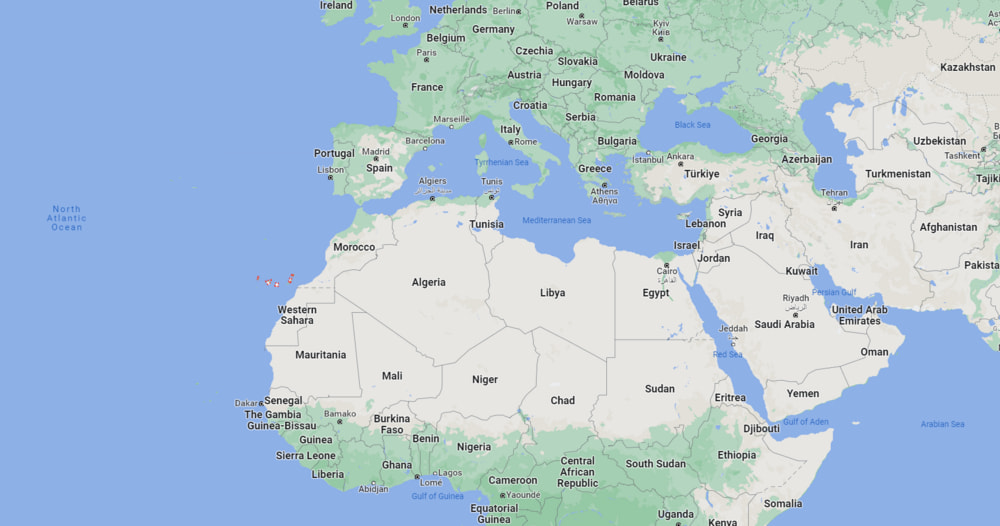 About Map: Map showing Where is Canary Islands, Spain located in the Map.
Canary Islands Map
About Canary Islands
The Canary Islands are a group of volcanic islands located in the Atlantic Ocean, off the northwest coast of Africa. Here are some key facts about the Canary Islands.
Geography: The archipelago consists of seven main islands: Tenerife, Fuerteventura, Gran Canaria, Lanzarote, La Palma, La Gomera, and El Hierro. In addition, there are several smaller islands and islets. The islands are of volcanic origin, and their landscapes vary from lush forests to arid desert-like areas.
Autonomous Community: The Canary Islands are an autonomous community of Spain. Each island has its own local government, and the archipelago as a whole has a degree of self-governance within the Spanish state.
Climate: The Canary Islands have a subtropical climate, characterized by mild winters and warm summers. They are often referred to as the "Islands of Eternal Spring" due to their pleasant and mild weather throughout the year.
Tourism: The Canary Islands are a popular tourist destination, attracting millions of visitors annually. The islands offer a diverse range of attractions, including beautiful beaches, stunning landscapes, nature reserves, water sports, and vibrant nightlife.
Natural Beauty: Each of the Canary Islands has its own unique natural beauty. For example, Tenerife is home to Mount Teide, the highest peak in Spain, and a UNESCO World Heritage site. Lanzarote is known for its volcanic landscapes and unique architecture created by local artist César Manrique.
Cultural Heritage: The Canary Islands have a rich cultural heritage influenced by the indigenous Guanche people, Spanish colonization, and African and Latin American influences. The islands host various festivals, traditional music and dance, and delicious local cuisine.
Biodiversity: The Canary Islands are home to a diverse range of plant and animal species, many of which are unique to the archipelago. Several areas on the islands are protected as national parks or biosphere reserves to preserve their natural ecosystems.
Overall, the Canary Islands offer a combination of natural beauty, pleasant climate, cultural richness, and recreational activities that make them a popular destination for tourists from around the world.
Canary Islands Facts, Spain
| Region Name | Canary Islands (Islas Canarias) |
| Region / Type | Autonomous Community and Archipelago |
| Capital Cities | Santa Cruz de Tenerife & Las Palmas de Gran Canaria (Co-capitals) |
| Country | Spain |
| Location | Located in the Atlantic Ocean off the northwest coast of Africa, near Morocco and Western Sahara. |
| Coordinates | 28.2916° N, 16.6291° W |
| Latitude | 28.29° N |
| Longitude | 16.62° W |
| Elevation | Highest point: Mount Teide, 12,188 ft (3,718 m) |
| Established / Founded | Official incorporation into Spain in 1496 |
| Incorporated as Autonomous Community | 1982 |
| Founded By | Indigenous Guanches (original inhabitants), later colonized by Castile |
| Population (2023 Estimate) | 2.2 million |
| Population Density (per sq mi) | Approx. 840 |
| Area (Sq mi) | 2,893 sq mi (7,493 km²) |
| Official Language | Spanish (Canarian dialect) |
| Demonym | Canarian (Canario/Canaria) |
| Currency | Euro (EUR) |
| Time Zone | WET (UTC+0) / WEST (UTC+1 DST) |
| Postal Code Range | 35000–38999 |
| Area Code | +34 |
| Government Type | Autonomous Parliamentary Government under the Kingdom of Spain |
| Main Industries | Tourism - Agriculture (Bananas, Tomatoes, Grapes) - Renewable Energy - Shipping - Volcanology Research |
| Major Highways | TF-1 (Tenerife) - GC-1 (Gran Canaria) - Multiple regional express routes |
| Rail / Tram Service | Tenerife Tram (Tranvía de Tenerife) - Proposed rail network expansion |
| Major Airports | Tenerife North Airport (TFN) - Tenerife South Airport (TFS) - Gran Canaria Airport (LPA) - Lanzarote, Fuerteventura, La Palma, El Hierro, La Gomera Airports |
| Climate | Subtropical / Mild Oceanic |
| Average Annual Temperature | 70°F (21°C) |
| Famous For | Beaches - Volcanic Landscapes - Mount Teide - Carnival Celebrations - Tourism - Biodiversity |
| Top Places to Visit | Mount Teide National Park - Maspalomas Dunes - Timanfaya National Park - Loro Parque - Teide Observatory |
| Sports Teams | UD Las Palmas (Football) - CD Tenerife (Football) - Local surfing, watersports, and basketball clubs |
| Sister Regions / Cities | Various Latin American and European partnerships |
| Nearest Major Cities | Casablanca (650 mi) - Madrid (1,100 mi) - Lisbon (850 mi) |
| Motto | "Océanos de Vida" (Unofficial: known as “The Eternal Spring Islands”) |
| Website | https://www.gobiernodecanarias.org |
World Travel Destinations
- 100 Wonders Of The World
- 7 Wonders Of World
- Where is Acropolis
- Where is Alhambra
- Where is Amalfi Coast
- Where is Amazon Rainforest
- Where is Angel Falls
- Where is Angkor Wat
- Where is Bali
- Where is Banaue Terraces
- Where is Bora Bora
- Where is Borobudur
- Where is Burj Khalifa
- Where is Cappadocia
- Where is Carlsbad Caverns
- Where is Chichen Itza
- Where is Colosseum Of Rome
- Where is Dubrovnik
- Where is Easter Island
- Where is Eiffel Tower
- Where is Fjords Of Norway
- Where is Galapagos Islands
- Where is Grand Canyon
- Where is Great Barrier Reef
- Where is Great Pyramid Of Giza
- Where is Great Wall Of China
- Where is Iguazu Falls
- Where is Konark Temple
- Where is Leaning Tower Pisa
- Where is Louvre Museum
- Where is Machu Picchu
- Where is Marrakesh
- Where is Matterhorn
- Where is Mecca
- Where is Mount Everest
- Where is Pagan Temples
- Where is Petra
- Where is Pompeii
- Where is Portofino
- Where is Potala Palace
- Where is Sahara Desert
- Where is Santorini
- Where is Sistine Chapel
- Where is Stonehenge
- Where is Suez Canel
- Where is Taj Mahal
- Where is Teotihuacan
- Where is Terracotta Warriors
- Where is Valley Of The Kings
- Where is Versailles
- Where is Victoria Falls
- Where is Mount Rushmore
- Where is Prague
- Where is Tunis
- Where is Curacao
- Where is Babylon
- Where is Death Valley
- Where is Tahiti
- Where is Oak Island
- Where is Mount Fuji
- Where is Timbuktu
- Where is Canary Islands
- Where is Monte Carlo
- Where is Atlantis
- Where is Dead Sea
- Where is Amalfi Coast
- Where is Kosovo
- Where is Great Barrier Reef
- Where is Panama Canal
- Where is The Red Sea
- Where is Aconcagua Mountain
- Where is Azores
- Where is Devil'S Tower
- Where is Antwerp
- Where is The Faroe Islands
- Where is Santorini
- Where is Kilimanjaro
- Where is Banff National Park
- Where is Mount Olympus
- Where is Ninevah
- Where is Mount Etna
- Where is Deadwood
- Where is Lake Titicaca
- Where is Yucatan Peninsula
- Where is Mount Mckinley
- Where is Angel Falls
- Where is The Blue Lagoon
- Where is Petrified Forest
- Where is Rock Of Gibraltar
- Where is Glass Beach
- Where is Atacama Desert
- Where is Mount Ararat
- Where is Falkland Islands
- Where is Channel Islands
- Where is Badlands National Park
- Where is Tree Of Life
- Where is Dubrovnik
- Where is Loch Ness